


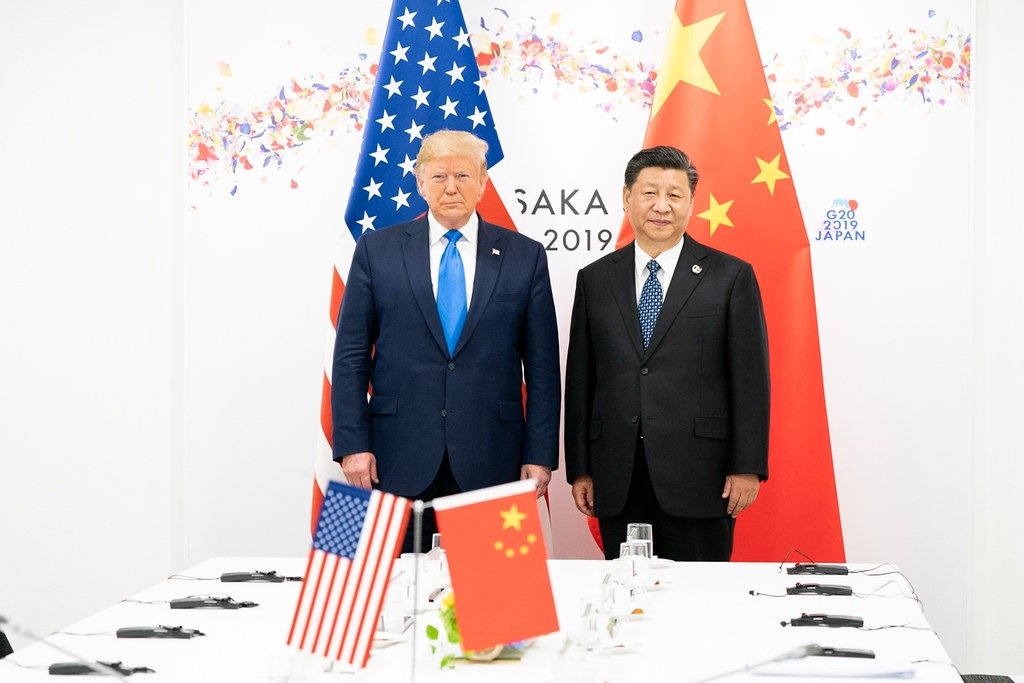
Officials from the US and China have been negotiating the framework of a potential trade deal ahead of Thursday’s highly anticipated meeting between US President Donald Trump and Chinese President Xi Jinping, their first face-to-face talks since 2019, according to a Guardian report.
The meeting, taking place on the sidelines of the Asia Pacific Economic Cooperation summit in Seoul, offers an opportunity to reset relations between the world’s two largest economies after months of global economic uncertainty caused by their trade disputes.
Trump expressed optimism when speaking to reporters on Air Force One Wednesday, saying, “I think we’re going to have a great meeting with President Xi of China, and a lot of problems are going to be solved”.
The US president suggested the sensitive topic of Taiwan might not feature in discussions. “I don’t know that we’ll even speak about Taiwan. I’m not sure. He may want to ask about it. There’s not that much to ask about. Taiwan is Taiwan,” Trump said.
Beijing claims Taiwan as a Chinese province and maintains a multifaceted campaign to pressure its government into accepting what it terms “reunification”. On Wednesday, Chinese officials reiterated warnings that they would “never” rule out military force to annex Taiwan if necessary.
Rare earth minerals are expected to be a key focus of the talks. China controls approximately 70% of global rare earth mining and more than 90% of processing capacity for these critical minerals, which are essential for US industries from automotive manufacturing to military equipment.
This month, Beijing increased restrictions on rare earth exports, citing national security concerns, shortly after the US expanded limits on advanced semiconductor technology exports to China.
In preliminary discussions held in Kuala Lumpur over the weekend, Beijing appeared willing to defer its new export controls for a year, likely in exchange for Washington freezing the new chip export restrictions. Such an agreement would benefit both economies, though critics in Washington may argue that easing chip export controls could undermine US long-term security interests.
Trump seems to be developing alternative rare earth strategies. On Tuesday, he and Japanese Prime Minister Sanae Takaichi signed an agreement to secure mining and processing of rare earths and other minerals, with the White House stating the countries would consider a complementary stockpiling arrangement.
Japan has successfully reduced its rare earth dependence on China from 90% to 60% since 2010, when a maritime dispute raised concerns about China potentially blocking exports.
China is also working to decrease its US dependence. On Tuesday, it signed an upgraded free trade agreement with the ASEAN bloc of Southeast Asian countries, which collectively represent China’s largest trading partner. Bilateral trade between China and ASEAN reached £580 billion last year, compared to £496 billion in US-China trade.
The looming threat of escalating tariffs hangs over the talks. In recent weeks, Trump threatened 100% tariffs on Chinese goods starting in November in response to rare earth restrictions, though these now appear likely to be averted.
As of 25 September, the average Chinese tariff on US exports was 32.6%, while the average US tariff on Chinese exports was 57.6%, according to the Peterson Institute for International Economics. In April, tariffs on both sides exceeded 130%.
“Both leaders see themselves and their countries as being in a very strong position,” said Bonnie Glaser, managing director of the Indo-Pacific programme at the US-based German Marshall Fund.
“Both want to avoid a return to the very high tariffs that they threatened each other with earlier this year”.
On Monday, Chinese Foreign Minister Wang Yi spoke with US Secretary of State Marco Rubio by phone. Wang acknowledged “setbacks” in the US-China trade relationship and called for both sides to uphold “the spirit of equality, respect and mutual benefit” in this week’s talks.
Trump and Xi are also expected to discuss controls on fentanyl and finalise the TikTok deal agreed in Madrid.
Beyond specific agreements, the summit’s greatest value may be demonstrating the potential for constructive dialogue between the world’s two most powerful leaders.
Trump has defied Washington hawks by adopting a relatively conciliatory tone with Xi, while Xi is “confident in his ability to manage Trump at this particular juncture,” according to Glaser.
Both sides appear interested in de-escalating the trade war. Feng Chucheng, partner at Hutong Research, an independent advisory firm based in Beijing and Shanghai, said, “There’s a growing revelation in the US that ‘mutually dependent coexistence may be beneficial’. In [that] sense that US paradigm on China is gradually shifting”.
(information from The Guardian)

