


Spectacular images of red sprites (also known as red lightning) that appeared in the sky over New Zealand are travelling around the world. This is one of the world’s rarest luminous phenomena, which was captured by three photographers.
New Zealand photographer Tom Rae and Spanish photographers Dan Zafra and Jose Cantabrana set out to photograph the Milky Way above the Ōmārama Clay Cliffs on the South Island on 11 October when they stumbled upon this unusual event.
The photographers thought they would be lucky just to have clear skies that evening, but the night became “unforgettable,” Rae told The Guardian website.
Red sprites are bursts of electrical energy in the upper atmosphere, produced by thunderstorms. Unlike lightning that strikes towards the ground, red sprites shoot upwards, towards the upper atmosphere, creating shapes that resemble columns, carrots, or even jellyfish. The first photograph of a red sprite was taken—by accident—in 1989, by a team at the University of Minnesota.
They are so brief—lasting only a millisecond—that they are rarely visible to the naked eye, but Rae was lucky. “I happened to be looking directly at one when it happened—just a perfect coincidence of looking at the right part of the sky, and I saw a brief red flash,” he said.
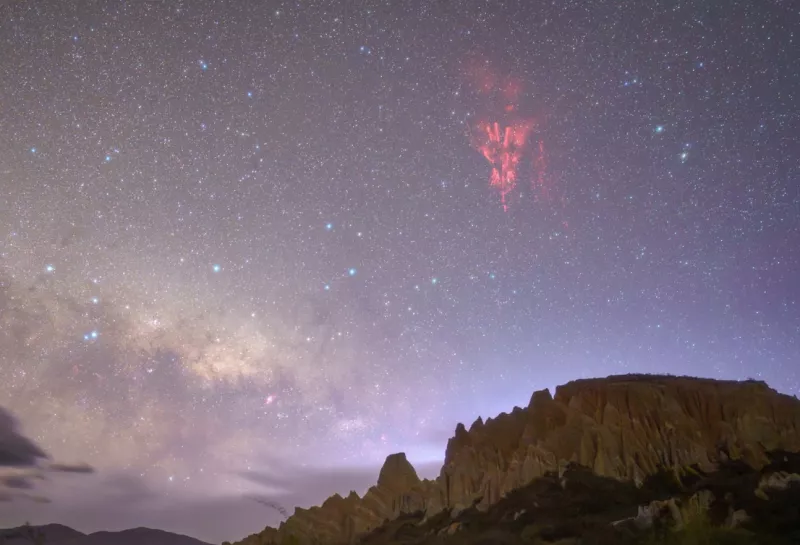
Observing the phenomena was a dream for Rae, an award-winning nightscape photographer. “It looks like you’re seeing something that isn’t real; it’s very ethereal… it’s this very deep red colour that’s there for a fraction of a second, so it’s really interesting to see.”
Capturing a red sprite requires excellent knowledge of photography technique, as well as an understanding of the science and creative inspiration, Rae said. “It’s a really complex kind of photography that is also very rewarding.”
Zafra said it was one of the “most special nights” of his life. “I could see the Milky Way shining above the horizon, while these huge red beams of light danced over a thunderstorm hundreds of kilometres away,” he said.
“It was one of those moments when you know you are witnessing something you will probably never see again,” he concluded.
(information from skai.gr)

