


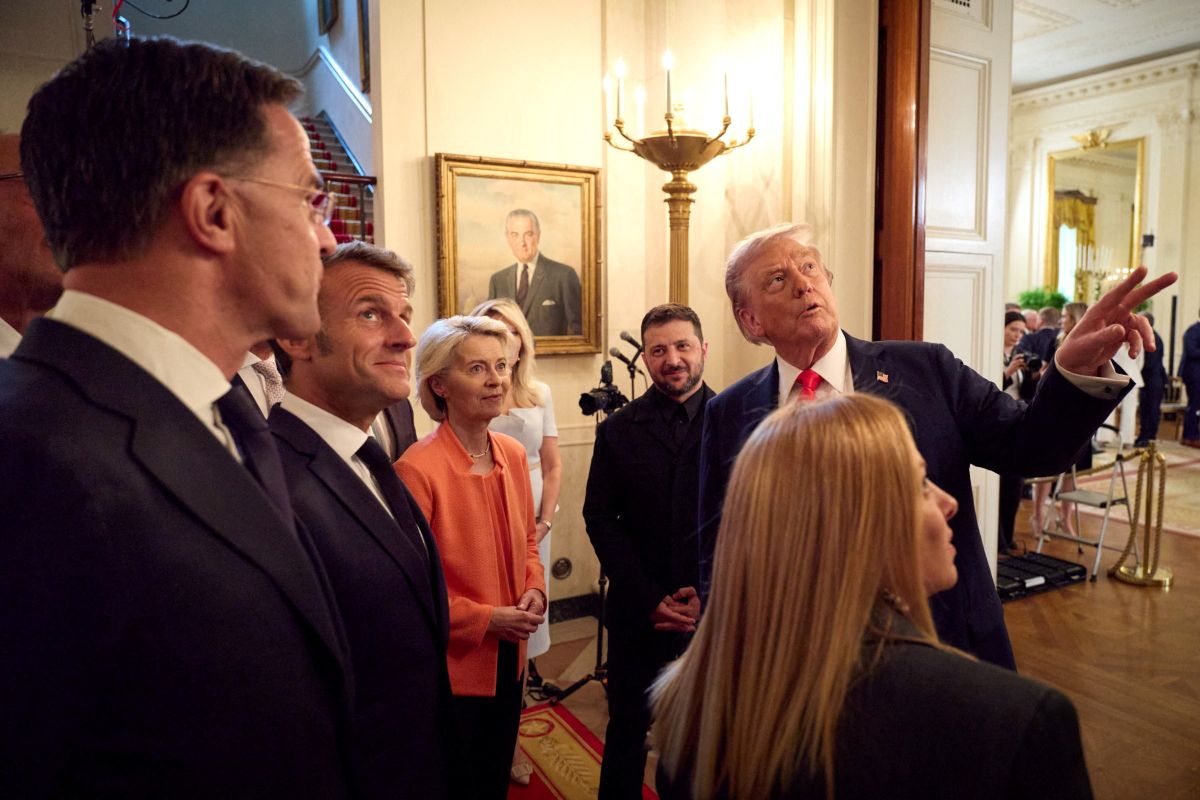
“We’re going to make sure it works. And I think if we can get to peace, it’s going to work. I have no doubt about it.” These were the statements by Donald Trump following the meeting he held on Monday at the White House with his Ukrainian counterpart, Volodymyr Zelensky, and other European leaders. The meeting was particularly significant as it set negotiations on track for resolving the Ukrainian issue.
Unlike the American president, others maintain considerable doubts about whether diplomatic contacts will lead to a comprehensive peace agreement on Ukraine. Although for the first time since the war began there are some faint hopes that the guns might finally fall silent, the aftermath remains murky and conceals many traps, particularly for Kyiv and its European allies.
Unfortunately, the grey areas are numerous. The issue of security guarantees is critical, but even more decisive is the matter of territorial concessions that Russia demands. If Russia succeeds, analysts comment, fears grow about what might happen in the future in other parts of the world, such as Cyprus. It is very likely that if Vladimir Putin gets what he asks for – and which Donald Trump unfortunately appears willing to grant him – revisionism will have won completely, leaving other dangerous prospects open.
Donald Trump appears ready to provide certain security guarantees for Ukraine, although he has ruled out NATO membership and the deployment of American troops, Manos Karagiannis, Professor of International Security at the University of Macedonia and King’s College London, told Phileleftheros. “This signals a possible shift towards a more active US role after the war ends. On the other hand, the presence of top European leaders was a deliberate display of unity. Their goal was to strengthen Zelensky’s position, prevent Trump from making unilateral concessions to Russia, and ensure that any peace agreement includes strong European participation. This collective diplomacy underscores Europe’s intention to remain a central factor in shaping Ukraine’s future and deterring Russian aggression,” he emphasised.
Immediately after the diplomatic contacts ended, Donald Trump stated that he favours providing strong security guarantees to Ukraine, as Volodymyr Zelensky persistently demands, even promising that the US would become involved, although Europeans would likely bear the main responsibility. Security guarantees for Ukraine constitute a significant part of the ongoing discussions and consultations, as the prospect of Ukraine joining NATO appears to have been ruled out for now, as this constitutes a red line for Moscow.
Donald Trump rejects the deployment of American forces as a peacekeeping force in Ukraine. Europeans understand that the heavy burden of security guarantees will fall on their shoulders, and this represents a serious responsibility for which they are seeking “partners”. Europeans appear to want to assign this role to Turkey, which in the past had declared itself ready and willing to deploy forces in Ukraine, highlighting the advantage of its good relations with both Moscow and Kyiv.
Equally important is convincing Ukraine that these guarantees will protect its security. “They’re not interested in such guarantees. They don’t care at all when President Trump says you can rely on me. They’re not going to agree or accept a political agreement that doesn’t give them the kind of security they want,” former US Ambassador to Kiev William B. Taylor Jr. was quoted as saying.
The coming days will be critical. In a post on Truth Social, Donald Trump noted that preparations have already begun for a meeting between the Russian and Ukrainian presidents and subsequently for trilateral talks with his participation.
The Russian president does not appear to rule out the possibility of meeting with his Ukrainian counterpart, but gave no indication that he is willing to accept a real reconciliation. Signs from Russia that it will not stop on the battlefield continue. While negotiations were taking place, Russia continued to bomb areas in Ukraine, killing civilians.
A ceasefire remains the major objective. “I don’t think you need a ceasefire,” Trump said, arguing that negotiations over a ceasefire could interfere with a larger peace deal. Since then, this has taken a back seat. Thus, it is very likely that negotiations between Kyiv and Moscow will begin without the preliminary stage of a truce – a shocking development for Ukraine, where civilians continue to be killed by Russian drone and missile attacks.
On the other hand, in Europe there is intense concern not only about the ambiguities of the impending agreement but also about the economic cost it will find itself paying. The EU today finds itself clearly between the US and Ukraine, and despite bridging the gap with the Oval Office, it will very likely have to dig even deeper into its pockets to ensure that its easternmost borders do not soon become battlefields. A trap that does not appear to be resolved quickly and easily.
Additionally, it must and should change quickly and effectively not just a process but significant parts of its rules and create a framework in which effectiveness and speed will be protagonists if it does not want to be the next major victim of those who plot against it. The stakes are high and today’s priorities are different, but this does not mean the problem can wait much longer.
Growing Concerns for Cyprus and Greece
The developments cause concern. “A potential peace agreement between Ukraine and Russia that includes territorial concessions could negatively affect the resolution of the Cyprus problem. The strategy of the Republic of Cyprus is based mainly on international law and the principle of territorial integrity to oppose the Turkish occupation of its territory. If Ukraine accepts an agreement that recognises, even indirectly, Russian control in the occupied areas, it creates a precedent that legitimises border changes through violence. This would encourage Turkey to push harder for a two-state solution in Cyprus or to seek international recognition of the Occupied Areas. Such an agreement would weaken the regulatory framework of intercommunal negotiations and reduce the EU’s credibility in defending the sovereignty of member states,” Manos Karagiannis said.
Revisionism is not merely a regional threat – it is a policy model that, if tolerated, will spread, and this is something that also worries Greece. Manos Karagiannis estimates that Greece’s reaction to the developments regarding Ukraine’s future reflects strategic bewilderment. “Athens has offered armoured vehicles, ammunition and training to Ukrainian forces, but does not wish to join the proposed European Multinational Force. Athens is also particularly cautious about any peace agreement that includes territorial concessions, fearing it could later provide legitimising cover for Turkish revisionism.”

