


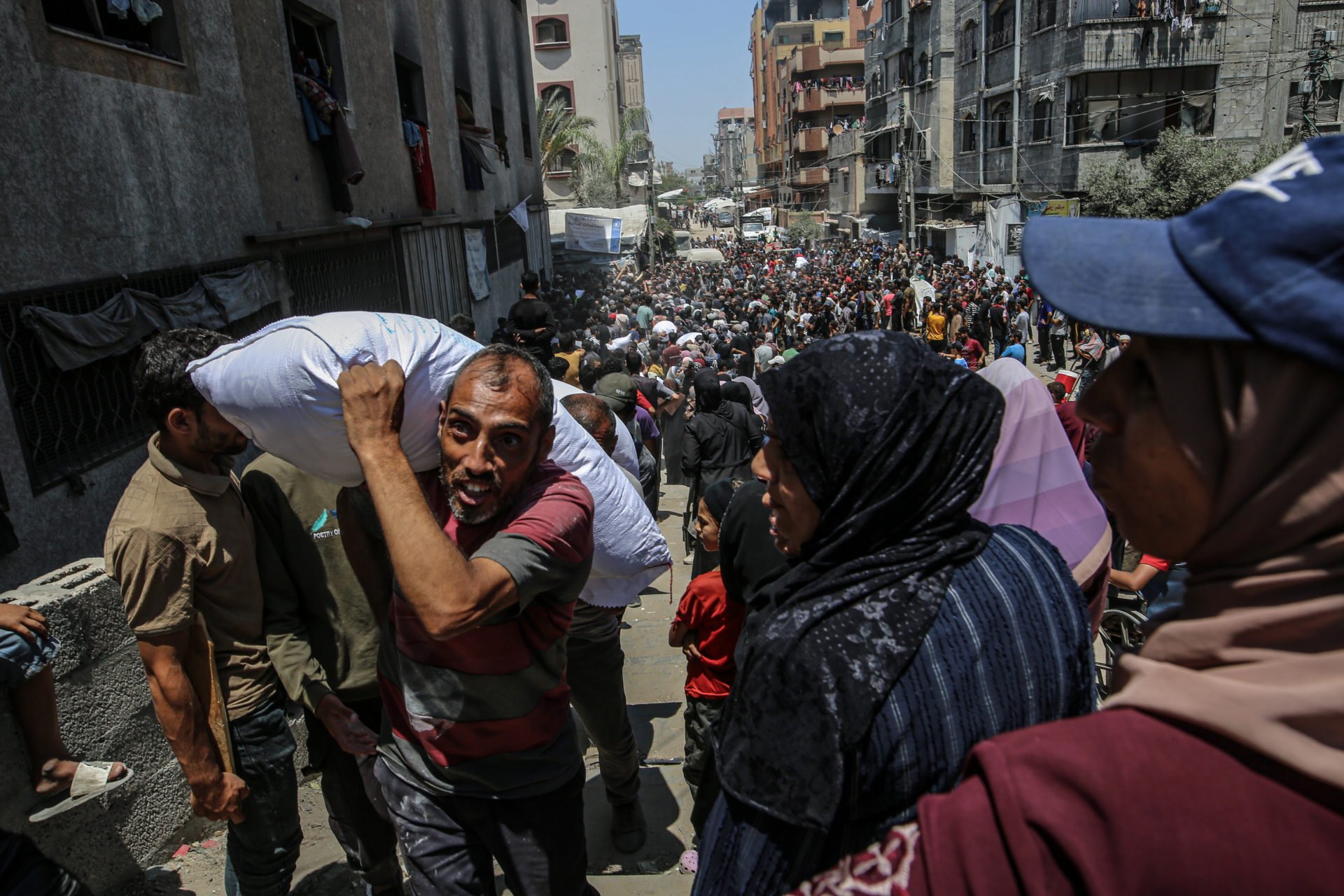
The UK and 27 other countries have called for an immediate end to the war in Gaza, saying civilian suffering has “reached new depths” and condemning Israel’s aid delivery system as dangerous.
The joint statement criticises what it calls the “drip feeding of aid and the inhumane killing of civilians” seeking food and water, marking a notably candid international rebuke of Israeli tactics.
Gaza’s Hamas-run health ministry said more than 100 Palestinians were killed by Israeli fire whilst waiting for food over the weekend, with 19 others dying from malnutrition since Saturday.
Israel’s foreign ministry rejected the countries’ statement, saying it was “disconnected from reality and sends the wrong message to Hamas”.
The ministry accused the armed group of spreading lies and undermining aid distribution rather than agreeing to a ceasefire and hostage release deal.
International condemnation
The signatories include foreign ministers from Australia, Canada, France, Italy, Japan, New Zealand and Switzerland, amongst others. Their statement declares: “The war in Gaza must end now”.
It warns that “the Israeli government’s aid delivery model is dangerous, fuels instability and deprives Gazans of human dignity”, adding: “We condemn the drip feeding of aid and the inhumane killing of civilians, including children, seeking to meet their most basic needs of water and food. It is horrifying that over 800 Palestinians have been killed whilst seeking aid”.
UK Foreign Secretary David Lammy told the House of Commons that a “litany of horrors” was taking place in Gaza, including strikes killing “desperate, starving children”.
Announcing an additional £40 million in humanitarian assistance for Gaza this year, Lammy said he remained “a steadfast supporter of Israel’s security and its right to exist” but that the government’s actions were “doing untold damage to Israel’s standing in the world and undermining Israel’s long-term security”.
Humanitarian crisis deepens
A UN Secretary General spokesperson said António Guterres was “appalled” by increasingly dire humanitarian conditions, warning that “last lifelines to keep people alive are collapsing”.
The spokesperson emphasised that “Israel has the obligation to allow and facilitate by all means at its disposal the humanitarian relief provided by the United Nations”.
Since May, when Israel partially eased an 11-week total blockade on aid deliveries, there have been almost daily reports of Palestinians being killed whilst waiting for food.
Israel and the US established a new aid system run by the Gaza Humanitarian Foundation (GHF) to bypass the existing UN-overseen system.
Israel says the GHF system, which uses US private security contractors to distribute food parcels from sites inside Israeli military zones, prevents supplies from being stolen by Hamas.
However, UN agencies have refused to cooperate, saying it is unsafe and violates humanitarian principles of impartiality, neutrality and independence.
Mounting casualties
The UN human rights office recorded 674 killings near GHF aid sites since operations began eight weeks ago, with another 201 killings recorded along UN and other aid convoy routes.
On Saturday, 39 people were killed near two GHF sites in Khan Younis and Rafah, according to Gaza’s health ministry. The Israeli military said troops fired warning shots to prevent “suspects” approaching before sites opened.
On Sunday, the ministry said 67 people were killed as they surged toward UN aid lorries near a crossing point in northern Gaza. The Israeli military said troops fired warning shots at a crowd “to remove an immediate threat” but disputed the casualty figures.
Starvation warnings
Following Sunday’s incident, the World Food Programme warned that Gaza’s hunger crisis had “reached new levels of desperation”, stating: “People are dying from lack of humanitarian assistance. Malnutrition is surging with 90,000 women and children in urgent need of treatment”.
Dr Khalil al-Daqran, a spokesperson for al-Aqsa hospital in Deir al-Balah, told the BBC: “Hospitals can no longer provide food for patients or staff, many of whom are physically unable to continue working due to extreme hunger. Hospitals cannot provide a single bottle of milk to children suffering from hunger, because all baby formula has run out from the market”.
Residents reported market closures due to food shortages. Mohammad Emad al-Din, a barber and father of two, told the BBC: “My children cry from hunger all night. They’ve had only a small plate of lentils over the past three days. There’s no bread. A kilogramme of flour was $80 (£59) a week ago”.
Calls for action
The 28-country statement also rejected Israeli proposals to move Gaza’s entire 2.1 million population into a “humanitarian city” in southern Rafah, noting that “permanent forced displacement is a violation of international humanitarian law”.
The countries urged Israel, Hamas and the international community to “bring this terrible conflict to an end, through an immediate, unconditional and permanent ceasefire”, warning they are “prepared to take further action to support an immediate ceasefire and a political pathway to security and peace” – seen by many as potential recognition of a Palestinian state.
Israeli foreign ministry spokesperson Oren Marmorstein rejected the criticism, saying: “All statements and all claims should be directed at the only party responsible for the lack of a deal for the release of hostages and a ceasefire: Hamas, which started this war and is prolonging it”.
The Israeli military launched its campaign in Gaza following the Hamas-led attack on southern Israel on 7 October 2023, in which about 1,200 people were killed and 251 others taken hostage.
At least 59,029 people have been killed in Gaza since then, according to the territory’s health ministry.
(information from The BBC)

