


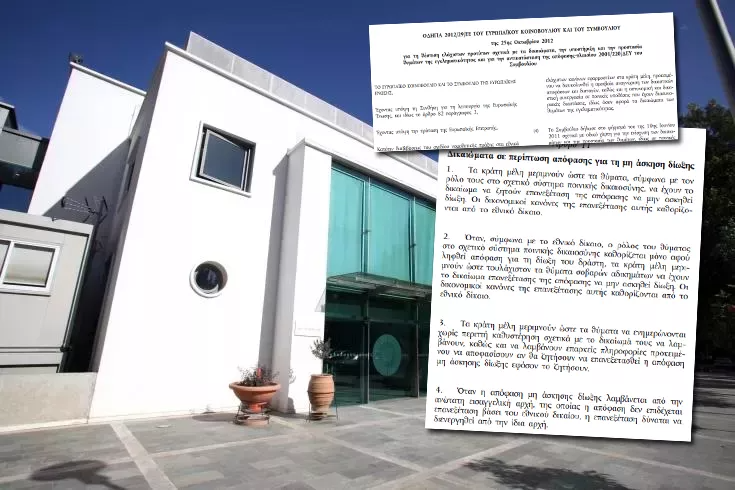
The Law Office bypassed a 2012 European Union directive concerning victim rights in a case involving alleged rape by a politician, according to case evidence examined by the European Court of Human Rights (ECHR).
The EU directive, incorporated into Cyprus’s national law in previous years, grants complainants the right to request prosecution authorities review decisions not to pursue charges against suspects.
Assistant Attorney General Savvas Angelides initially ordered the case registered in court, but subsequently decided in December 2021 to discontinue criminal prosecution against the suspect, A.T., citing new evidence.
Legislative gaps
Cyprus’s Parliament enacted harmonising legislation in 2016 and amended it six years later, but included no provision allowing complainants to initiate review procedures of Attorney General decisions.
The legislation also fails to establish explicit provisions requiring the Attorney General to promptly inform complainants about decisions not to prosecute or suspend prosecution of suspects.
The directive stipulates that relevant authorities must provide prompt and adequate information regarding their decision not to prosecute an accused person, ensuring the complainant’s right to seek review.
ECHR intervention required
The complainant’s attempts to access details about her case decision proved unsuccessful until the European Court of Human Rights intervened.
The ECHR ruling states that the case complainant had only telephone contact with the Law Office official handling the case.
The ECHR verdict documents the following sequence of events:
- On 3 December 2021, the prosecutor informed the applicant by telephone of the decision to cease criminal prosecution.
- On 27 December 2021, the applicant requested a copy of the Attorney General’s decision to cease prosecution and to learn the reasons for this decision. She also requested review of the decision to terminate proceedings against A.T.
- In a letter dated 4 January 2022, the Assistant Attorney General replied that the above decision had been communicated to the applicant by the prosecutor from his office. The competent prosecutor had explained to the applicant that prosecution had ceased following review of evidence, specifically statements given by the applicant after the case’s court registration, which included new claims and evidence not in the case file when the decision to prosecute A.T. was taken.
- In a letter dated 4 February 2022, the applicant replied that, although she had briefly discussed the decision’s reasons with the prosecutor by telephone, she continued to desire official notification of the reasons for ceasing prosecution after reviewing her supplementary statements and evidence.
- The applicant also requested copies of criminal case file 3428/21, her police statements, and other relevant documents related to her 10 April 2021 complaint.
- In a letter dated 21 February 2022, the Assistant Attorney General replied that reasons for ceasing prosecution had already been explained by the prosecutor. He reiterated that evidence required review because the applicant had given two supplementary statements containing new claims unknown to the Attorney General’s office when the prosecution decision was taken. The applicant’s request for case file copies was rejected.
- In September 2022, following the complainant’s legal procedures, the ECHR called on government authorities to submit a copy of the file concerning criminal investigation related to the applicant’s rape complaint.
EU directive requirements
EU Directive 2012/29 (25/10/2012) aimed to establish minimum standards regarding crime victim rights, support and protection. Cyprus’s Parliament passed the “Law on Establishing Minimum Standards regarding Crime Victim Rights, Support and Protection” (2016 (51(I)/2016)) to harmonise with this European act.
Article 11 of the EU directive has two basic parameters: (1) Prompt adequate notification to complainants about reasons for discontinuing criminal prosecution, enabling (2) the right to request review of prosecution authority decisions.
The complete Article 11 states:
“Member states shall ensure that victims, in accordance with their role in the relevant criminal justice system, have the right to review of a decision not to prosecute. The procedural rules for such review shall be determined by national law.
“Where, in accordance with national law, the victim’s role in the relevant criminal justice system is established only after a decision to prosecute has been taken, Member states shall ensure that at least victims of serious crimes have the right to review of a decision not to prosecute.
“Member states shall ensure that victims are notified without unnecessary delay of their right to receive, and to receive adequate information to decide whether to request review of a decision not to prosecute if they so request.
“Where the decision not to prosecute is taken by the highest prosecuting authority, whose decision is not subject to review under national law, the review may be undertaken by the same authority.”
Cyprus’s related legislation includes no review provision, nor distinct reference based on the EU directive ensuring alleged victims receive prompt and adequate notification of Law Office decisions on prosecution suspension or non-prosecution of suspects.
Read more:

