


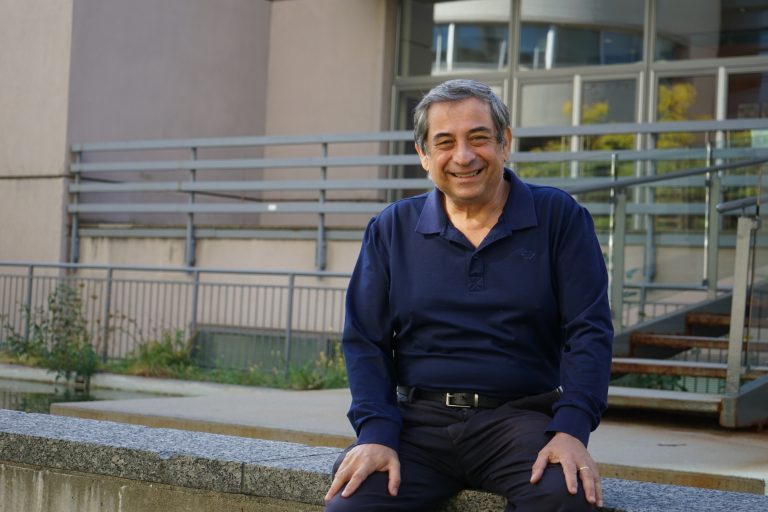
Cypriot scientist George Eleftheriades has been awarded the 2025 IEEE Electromagnetics Award, the highest global recognition in electromagnetic research, marking a rare achievement for European scientists in a field traditionally dominated by American researchers.
The award recognises his contributions to the field of metamaterials and metasurfaces. Eleftheriades pioneered the use of transmission lines to implement negative-index metamaterials and, with his research team, achieved the first experimental imaging beyond the diffraction limit using a Veselago-Pendry lens.
More recently, he developed “field-discontinuity metasurfaces” – two-dimensional metamaterial analogues that enable unprecedented control of electromagnetic waves. These innovations have applications in 5G/6G wireless systems, imaging systems beyond diffraction limits, and radar invisibility cloaks that minimise reflection.
“I still find it hard to believe,” Eleftheriades told Phileleftheros, describing it as the pinnacle achievement in his field. He noted that only two or three European scientists have previously received this distinction from the IEEE, the world’s largest technical professional organisation with presence in more than 190 countries.
Distinguished academic career
Eleftheriades, who was born and raised in Limassol, is a professor in the Department of Electrical and Computer Engineering at the University of Toronto, where he holds the Velma M. Rogers Graham Chair in Nano and Micro Structured Electromagnetic Devices.
In Cyprus, he was consistently at the top of his class, first at Laniteio High School (formerly Fifth Gymnasium) in Limassol, then at the National Technical University of Athens where he graduated with distinction in Electrical Engineering, before earning his master’s and doctoral degrees from the University of Michigan in 1994.
After completing his studies, he worked at the Swiss Federal Institute of Technology in Lausanne (EPFL), collaborating with the European Space Agency, before moving to Canada in 1997 where he has been based since.
From 2005 to 2019, he also held the Tier-1 Canada Research Chair in Micro and Nano Structured Electromagnetic Materials and Devices at the University of Toronto.
Revolutionary technologies
Metamaterials, as Eleftheriades explains, are artificial materials with electromagnetic properties not found in nature, such as negative refractive indices that bend light in the opposite direction compared to conventional materials like glass.
The practical applications of these materials are diverse and increasingly present in everyday technology. They allow for smaller antennas and flat-surfaced lenses rather than curved ones, and microscopes with resolution beyond the diffraction limit.
One application involves increasing wireless network capacity through reflection on metasurfaces, essentially providing better reception for mobile phones and internet connectivity.
The materials also have medical applications, including improving MRI resolution for higher clarity images and creating thin beams of radio waves for epilepsy treatment. Specifically, these beams can irradiate the brain through a helmet without requiring surgical intervention.
Invisibility technology
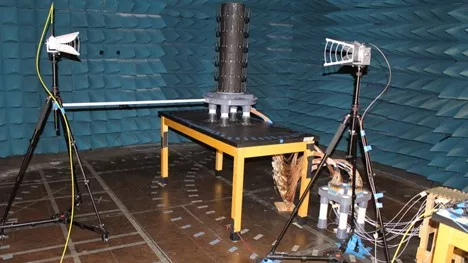
Perhaps his most publicised innovation is an invisibility cloak that guides electromagnetic waves around an object to render it undetectable by radar.
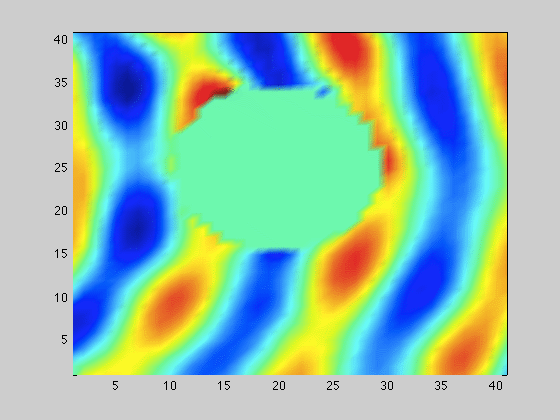
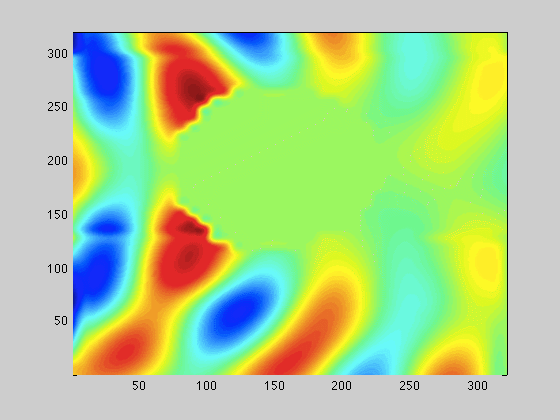
“With metamaterials, we can create a cloak that guides light around the object without absorbing or reflecting anything, thus making it invisible,” Eleftheriades explained. “Instead, we constructed a thin cloak that cancels out scattered radio waves. It essentially emits radio waves opposite to those of reflection, cancelling them out. This makes the object invisible to radio waves and undetectable by radar.”
The professor said that this cloak doesn’t make objects invisible to the human eye. Such visual invisibility “could be achieved in a similar way by cancelling light instead of scattered radio waves, but constructing such a cloak would be much more difficult,” he noted.

