


By Antonis Pastellopoulos, Postdoctoral Researcher, University of Cyprus
“He came to Britain in October 1970. He was studying for four years in Ealing Technical College. After the tragic summer of ‘74, when his family became refugees he was forced to give up his studies because he had no money to continue. He applied for renewal of his visa and asked for a work permit. For the last two and a half years the Home Office has been considering his case. He has received no answer to his application. On the 18th of January ‘77 he was arrested and was imprisoned in Pentonville. He will soon be deported. He has not been charged with anything and has not appeared in court.”
This is but one of the many cases recorded in a trilingual pamphlet regarding Cypriot refugees that was distributed in London in the 1970s, as part of a broader campaign defending Cypriot refugees and migrants facing police harassment, deportations, economic exploitation, and family separation. While many Cypriots had already migrated to the UK by the mid-20th century, an additional 20,000 Cypriots further migrated following the Turkish invasion of 1974. Being granted temporary visas, they remained at the mercy of the British state for their renewal, facing harassment, arrests, fines, imprisonment and deportations.
The experience of Cypriot refugees in the UK has been largely left out of codified Cypriot history. A quintessentially bicommunal experience, it is much more closely linked to the experiences of other migrant communities making a new beginning in Britain, rather than that of post-war Cyprus itself. It is thus a history that is seldom remembered within the island, not surviving in collective memory. What is more commonly heard is an idealized narrative of Cypriot migration, one of legal entry, smooth integration, and community success, that distances itself from the harsher realities of refugeehood in 1970s Britain. This narrative tells us more about the self-image of Cypriots on the island than the lived experiences of those displaced by the war.
Despite its specific context, the experience of Cypriot refugees in Britain closely mirrored that of other migrant communities escaping war, poverty, and persecution – a reality encapsulated in a 1977 exposé on Cypriot women in Britain compiled by Di Watts:
“One of the most worrying problems is that, since the 1974 war in Cyprus, many of the women are working illegally in this country because the Home Office refuses to give them refugee status. The threat of deportation and not having the right sort of work permit makes it easier for bosses to exploit them and more difficult for them to fight back…The Home Office have been using the racist immigration laws to deport a number of Cypriot refugees. And it is not only refugees but other Cypriot workers who are being kicked out of this country, put in jail and threatened with deportation. Immigration controls are increasingly being used to turn away Cypriot refugees who want to take refuge here.”
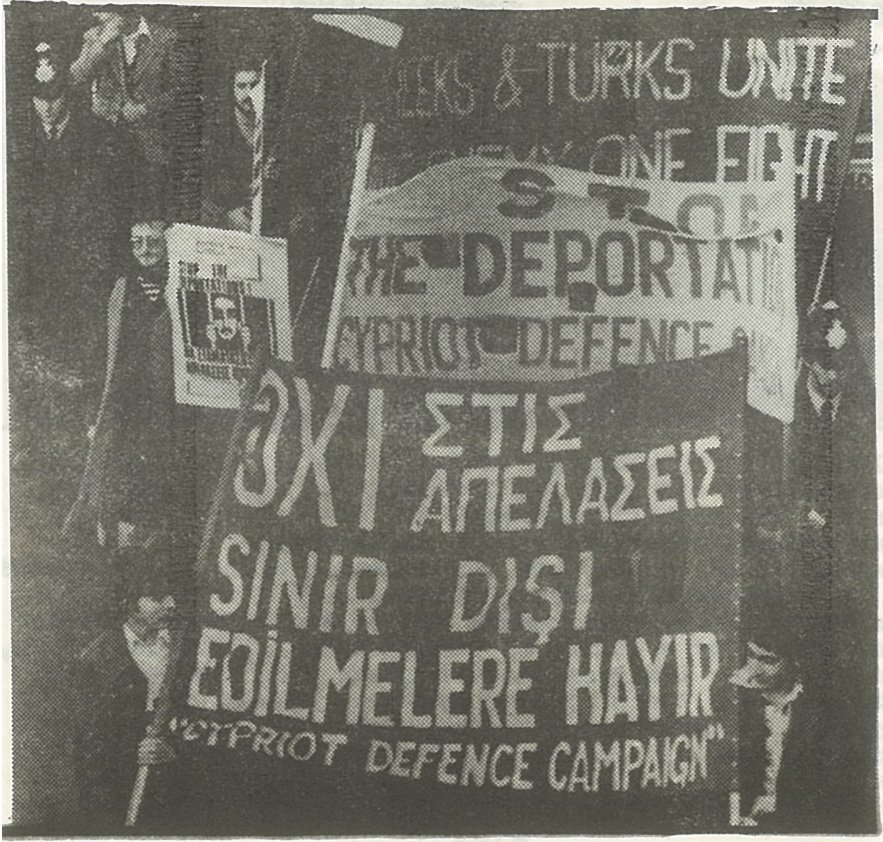
Cypriot migrants and refugees did not passively accept these conditions, organizing politically to oppose the policies of the Home Office. This took the form of the Cypriot Defense Campaign, set up by Cypriots active in the British Socialist Workers Party (SWP), then an important political actor in British grassroots left-wing politics. Organizing open meetings, demonstrations, and petitions, the Cypriot Defense Campaign set out a set of key demands, including the end of the deportations of Cypriots, the recognition of Cypriots as refugees rather than as ‘long term visitors’ and the safeguarding of their right to work legally in the British economy. Crucially, the Campaign linked its demands to the broader demands of migrant communities within Britain, calling for these rights to be granted to all migrants and for “an end to all immigration controls”.
One notable moment in the Campaign’s history is perhaps the picketing of president Archbishop Makarios III during his visit to a local Greek Orthodox church in June of 1977. In its open letter to the Cypriot president, the campaign stated that it is “fighting against the deportations”, calling on Makarios to pressure the British Prime minister to “stop these racist attacks against our community”, further noting that:
“Not more than a mile from the church you are conducting the mass, on Sunday 12 of June, Cypriots are rotting in prison! Is it because they are criminals? The answer is NO! It is because they are Cypriots and more specifically because they are refugees. For to be a refugee of the 1974 war in Cyprus, it is a crime in Britain today. Men and women have been split from their families and have been imprisoned for months. Nearly every Cypriot family -Greek and Turkish- know relatives and friends that have been imprisoned and deported. And this because the Home Office has decided to force thousands of refugees to become illegal by refusing to extent their visa.”
Featured image description: Demonstration against deportations organized by the Cypriot Defense Campaign on 05/02/77 in London. Photo located in issue 15 of the ‘Cypriot Worker’ newspaper.
This article is part of a series exploring themes of refugeehood and emplacement in relation to Cyprus.


