


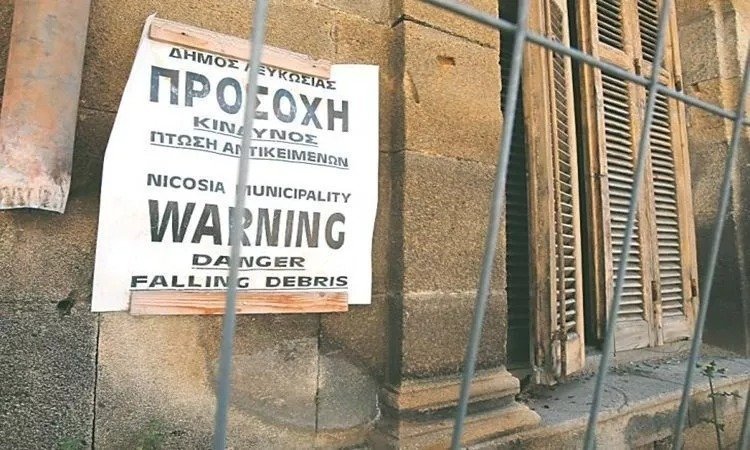
Authorities are taking steps to address 1,292 buildings deemed dangerous and at risk of collapse, posing a threat of casualties or injuries.
New legislation is being proposed and additional state funding allocated to tackle the issue, it has been announced.
Of the identified dangerous structures, 618 are located in Nicosia, 308 in Limassol, 170 in Larnaca, 26 in Famagusta, and 170 in Paphos.
MP Marinos Mousiouttas is submitting a draft law, having secured the agreement of the Interior Minister, to improve safety and address shortcomings in existing legislation that fails to adequately protect the public, affected properties, and neighbouring buildings.
In a move to support District Local Government Organisations (DLGOs) now responsible for these dangerous buildings, state contributions will increase to €500,000 for properties in Nicosia. Similar funds, though insufficient to support all affected buildings, will be allocated for dangerous structures in other districts.
Following a meeting with Mousiouttas, Interior Minister Constantinos Ioannou stated that a revised proposal to the current law was jointly formulated by the House Interior Committee, at Mousiouttas’ initiative, with public safety as the priority for more effective management of dangerous buildings.
Ioannou noted that weaknesses in the existing legal framework were identified in collaboration with the Unions of Municipalities and Communities, and the DLGOs. These weaknesses hindered the effective implementation of the legislation, allowing only some local authorities to enforce provisions and deterring others from taking decisive action.
With the transfer of responsibility for dangerous buildings to the DLGOs effective from yesterday, a series of legislative changes are being advanced. These changes will tighten the framework for monitoring and enforcement in cases of non-compliance. A key element is the shift of responsibility for rendering buildings safe to the owners, through the introduction of enforcement measures to pressure them into taking action.
The proposed amendments include simplified procedures for serving notices to owners and the possibility of issuing court orders through ex parte applications for necessary measures. Furthermore, the use or rental of a building deemed dangerous will be prohibited until the hazard is rectified. Provisions are also included for the full or partial demolition of dangerous buildings and the disconnection of water and electricity supplies. The draft law also incorporates measures for the registration of a memo on the affected properties to cover intervention costs, as well as the introduction of out-of-court settlements and increased administrative and criminal penalties for non-compliance.
Previously, Ioannou noted, authorities often faced a lack of financial resources to manage dangerous buildings. To address this, the Interior Ministry has secured additional financial support, which will be granted to the DLGOs through the municipalities. This will be based on the registration of dangerous buildings within each municipality’s boundaries and according to a jointly developed plan by the DLGOs and municipalities for their gradual restoration.
Read more:

