


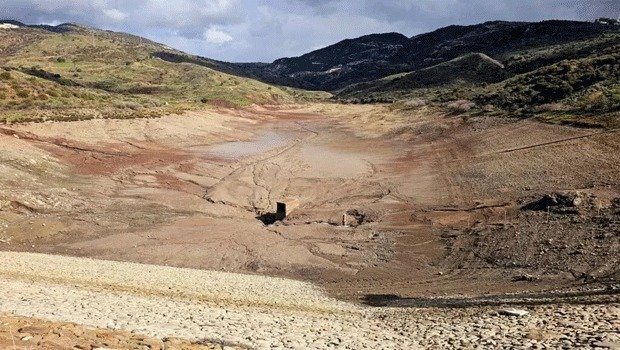
Cyprus is heading towards one of the most severe water crises in its history, with government forecasts indicating dam reserves will reach critically low levels by the end of 2025, according to scenarios being developed by the Water Development Department (WDD).
The department projects that water reserves in the Southern Conveyor Project (SCP) dams will plummet from 46 million cubic metres currently to just 8 million cubic metres by year-end. The situation in Paphos is even more dire, with reserves expected to fall from 18 million cubic metres to merely 1.7 million cubic metres.
The crisis comes as existing desalination plants are already operating at maximum capacity but still cannot meet growing water demands. Rising consumption, insufficient rainfall and climate change are exacerbating the already strained situation.
In response to dwindling resources, water allocated for irrigation will be reduced by 50 percent in 2025, severely impacting farmers and agricultural production, particularly fruit and vegetable cultivation.
According to a Cabinet decision dated 3 January 2025, the SCP will allocate 90 million cubic metres for domestic use and 21.7 million cubic metres for irrigation this year. However, the WDD has been forced to revise allocation scenarios due to reduced dam inflows, falling from 16.7 million cubic metres to 9.2 million cubic metres annually.
Additional pressure comes from a 5 percent reduction in desalinated water production due to essential equipment maintenance, alongside a 5 percent increase in domestic water demand driven by rising tourism, increased household consumption, and expansion of water networks to new areas.
Water reserves in SCP dams will barely cover needs until the end of 2025, provided the scenario is strictly adhered to and both irrigation and domestic water demand remain within calculated quantities, the WDD stated.
The department warns that the most significant challenge will occur during peak summer demand in Limassol province. While the Limassol water treatment plant has a daily capacity of 80,000 cubic metres, increased silt content in water from Kouris dam could significantly reduce its efficiency when reserves are at their lowest.
To support affected farmers, the Department of Agriculture is developing a compensation scheme for income losses.
The crisis has been compounded in Paphos by lower-than-expected rainfall, the destruction of the Kouklia desalination plant, and the complete loss of water volume from Mavrokolympos dam.

