


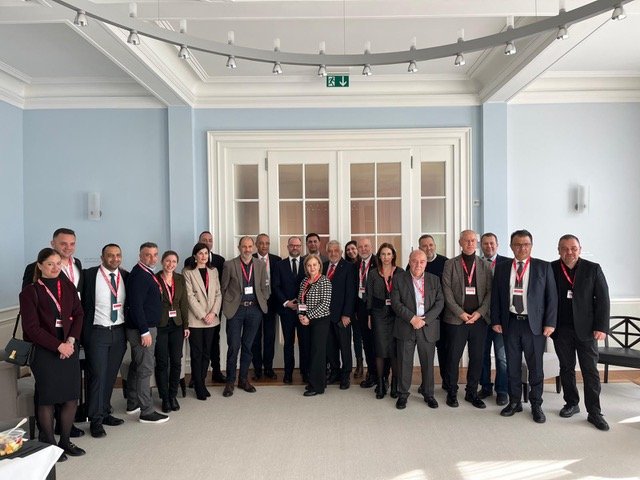
Representatives from multiple Cyprus political parties have concluded a five-day study visit to Switzerland focusing on governance models and political systems, according to a press release from the Cyprus Dialogue Forum (CDF).
The delegation, which visited Switzerland between 2-7 March 2025, included members from Greek Cypriot political parties AKEL, DISY, DEPA and Volt, alongside Turkish Cypriot parties CTP, DP, HP and UBP, as well as former chief negotiators from both communities.
The visit, jointly funded by the European Union and Switzerland’s Federal Department of Foreign Affairs, provided participants with insights into Switzerland’s federal governance model, examining principles of cooperation, compromise, subsidiarity, collegiality and direct democracy mechanisms.
Participants engaged with various Swiss officials across multiple levels of government during the comprehensive programme. The delegation began with briefings on the Swiss political system’s historical development, including presentations from the Institute of Federalism and discussions with Ambassador Claudio Fischer on Switzerland’s direct democracy approach.
State Secretary Alexandre Fasel met with the delegation to discuss the balancing mechanisms within Switzerland’s decentralised political framework, while Ambassador Lauper provided perspectives on Switzerland-EU negotiations with emphasis on consultation and transparency processes.
The study visit included examination of Switzerland’s fiscal federalism with representatives from the Federal Finance Administration explaining financial autonomy balancing mechanisms.
At the cantonal level, the group was hosted by the Canton of Bern, meeting with various officials including the Swiss Minister for Economy, Energy and Environment and receiving a formal welcome from the plenary session of the Cantonal Parliament, led by its President Dominique Bühler.
The final day focused on municipal governance, with the delegation visiting the Commune of Gruyère in Fribourg Canton to examine local decision-making processes.
According to the press release, participants recognised that while each political system reflects unique circumstances, Switzerland’s experience offers valuable insights regarding governance approaches, decentralisation models and consensus-building mechanisms.

