



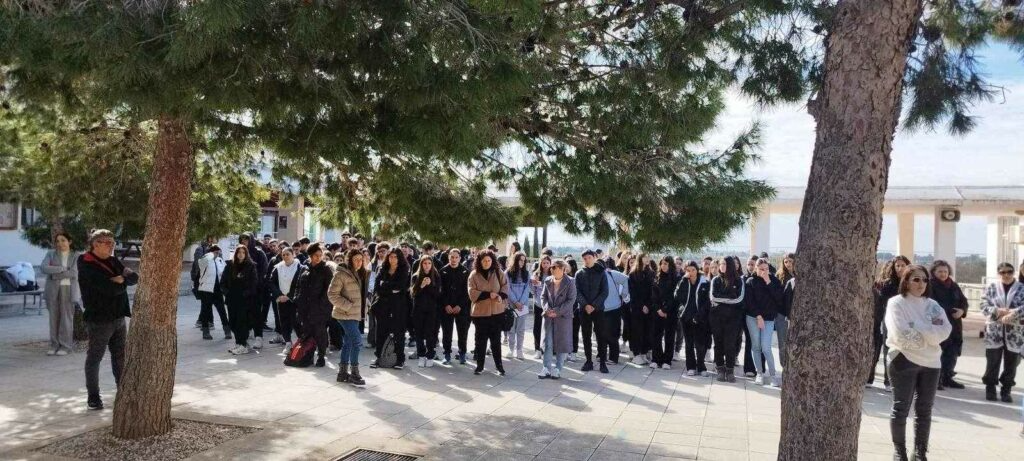
Students and teachers at Kokkinochoria High School held a solemn memorial service commemorating 23-year-old Kyprianos Papaioannou, who died in the Tempi railway disaster in Greece exactly two years ago.
During the first break, students gathered in the school courtyard where Kyprianos had once studied, for a memorial service.
Two years ago, Avgorou was stunned by news that one of the six children of community priest Christodoulos Papaioannou was among those missing after the railway accident at Tempi.
Kyprianos’s body was identified several days later. The 23-year-old, who studied at Aristotle University of Thessaloniki, had travelled to Athens to meet his fiancée who had come from Cyprus.
After visiting a Greek island together, his fiancée returned to Cyprus while Kyprianos boarded the ill-fated train travelling from Athens to Thessaloniki, which collided with a freight train travelling in the opposite direction shortly after 11pm on 28 February.
Among the victims was also 24-year-old student Anastasia Adamidou from Paphos.

The train disaster in Tempi
On February 28, 2023, a train collision occurred near Tempi, Greece, resulting in 57 fatalities and numerous injuries. The incident involved a passenger train traveling from Athens to Thessaloniki and a freight train on the same track, leading to a head-on collision. The majority of the victims were university students returning from a holiday weekend.
Investigations into the disaster identified critical safety lapses within Greece’s railway infrastructure. A report by the Hellenic Air and Rail Accident Investigation Authority (HARSIA) highlighted that the collision was primarily due to human error by the Larissa station master, who manually set the train’s route incorrectly. Additionally, the report pointed to outdated infrastructure, incomplete modernisation projects, and insufficient safety systems as contributing factors. The absence of automated signaling and train protection systems, such as the European Train Control System (ETCS), left the network vulnerable to such tragedies.
Critiques of the Tempi train disaster have primarily focused on the consequences of neoliberal policies, particularly the privatisation of Greece’s railway system. Critics argue that the transfer of public assets to private entities, driven by austerity measures and neoliberal economic reforms, has led to underinvestment in infrastructure and compromised safety standards.
Following the tragedy, progressive groups, including workers’ and student organisations, expressed outrage over the deteriorating state of the country’s railways. Demonstrations highlighted how austerity-driven policies and privatisation had exacerbated systemic issues, leading to negligence and a lack of accountability. Protesters described the incident as a “predetermined crime with causes and culprits,” emphasising the role of neoliberal reforms in undermining public safety.
Mass protests and strikes have been organised, with citizens demanding accountability and comprehensive reforms to prevent future incidents. On the second anniversary of the disaster, widespread demonstrations and a general strike brought the country to a standstill.
Research conducted by Eteron, an institute for research and social change, revealed that a significant portion of the youth population holds neoliberal policies responsible for the disaster. The study found that 38.3% of young respondents favored the re-nationalisation of all passenger services, indicating a lack of confidence in privatized management of essential services.
Read more:

