


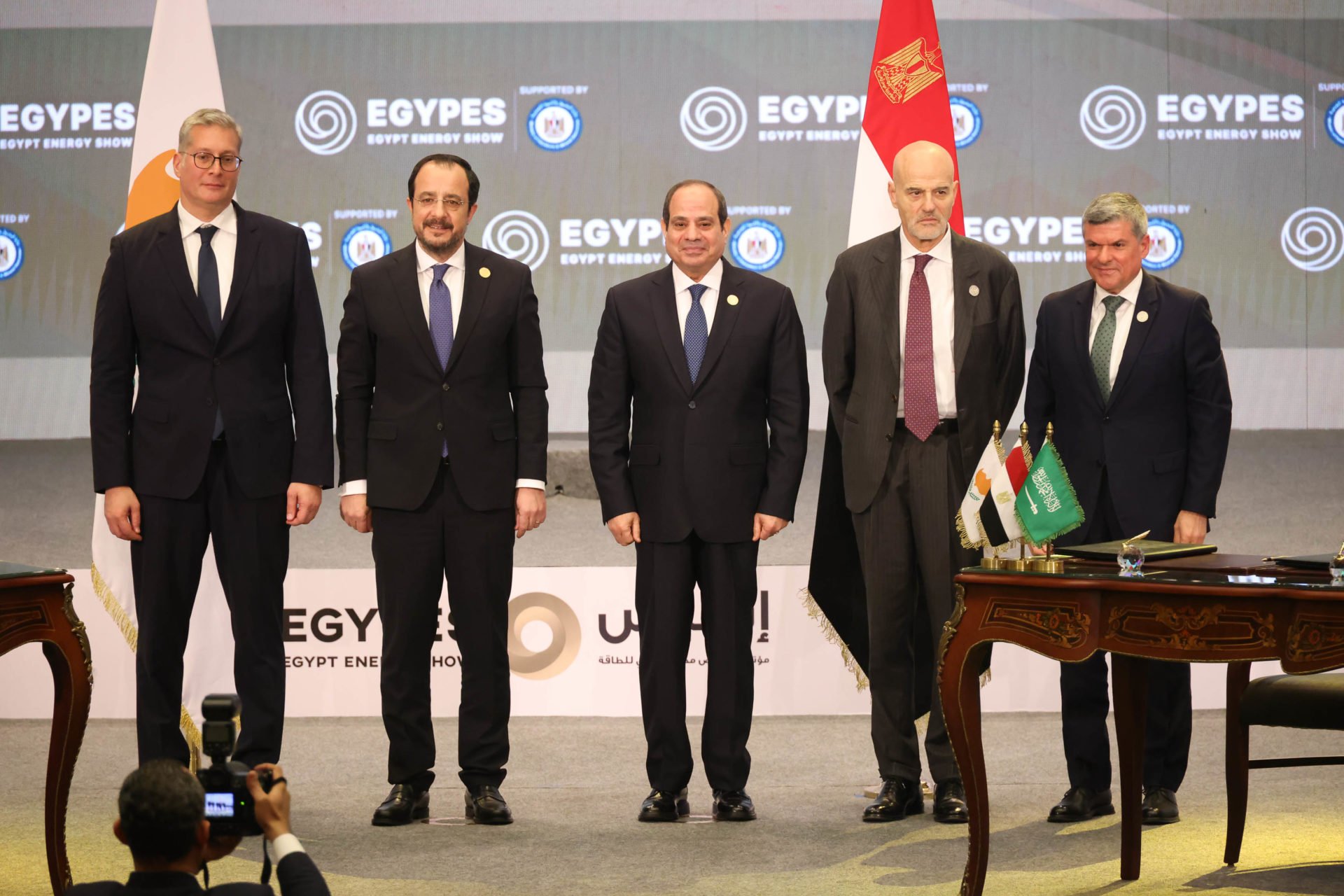
Cyprus and Egypt signed key energy agreements on Monday for the development of Block 6 and the Aphrodite gas field.
President Christodoulides and Egyptian President Abdel Fattah al-Sisi witnessed the signing ceremony at the EGYPES 2025 energy exhibition in Cairo’s Al-Manara Conference Centre, alongside Italy’s Deputy Prime Minister.
The agreements include a Host Government Agreement for Block 6 development and a Memorandum of Understanding between Cyprus, Egypt, and the licensee consortium comprising Chevron Cyprus Limited, NewMed Energy LP, and BG Cyprus Limited for the Aphrodite gas field development.
“The signing of the two agreements are pivotal for our strategic partnership. They are game changers for the region and beyond,” President Christodoulides said in a post on X.
The signing of the 2 agreements are pivotal for our strategic partnership. They are game changers for the region and beyond. At these challenging times, 🇨🇾 and 🇪🇬 pave a new path, and in doing so, show the way. And we prove, yet again, that we are reliable, predictable partners pic.twitter.com/jRjHxVihX4
— NikosChristodoulides (@Christodulides) February 17, 2025
During their bilateral meeting, both presidents emphasised the agreements’ significance in implementing substantial energy cooperation between the two countries, viewing it as a model for promoting peace, stability, and development in the Eastern Mediterranean region.
The leaders also discussed EU-Egypt relations, bilateral cooperation in tourism, trade, and investments, and the seasonal employment of Egyptians in Cyprus. Christodoulides updated al-Sisi on recent developments in the Cyprus issue and efforts to resume negotiations.
Cyprus’s delegation included Foreign Minister Constantinos Kombos, Energy Minister George Papanastasiou, and other senior officials.
The Energy Minister will participate in a Ministerial Round Table Discussion on energy security and industrial competitiveness as part of EGYPES 2025.
Context
The Aphrodite gas field, discovered off the coast of Cyprus in 2011, is estimated to contain around 124 billion cubic meters of natural gas. Its development has been a key priority for the Cypriot government, however, the project has faced hurdles, including complex negotiations, technical challenges, and regional geopolitical considerations.
The development plan submitted by Chevron and its partners, Shell and NewMed, outlines a new strategy for extracting and utilising the gas, focusing on a more efficient and cost-effective approach. Instead of constructing extensive onshore facilities in Cyprus, Chevron aims to export the gas to Egypt via a subsea pipeline, leveraging existing infrastructure there.
This decision has paved the way for the project to move forward, with the partners now working towards a final investment decision that will greenlight construction and development.

