


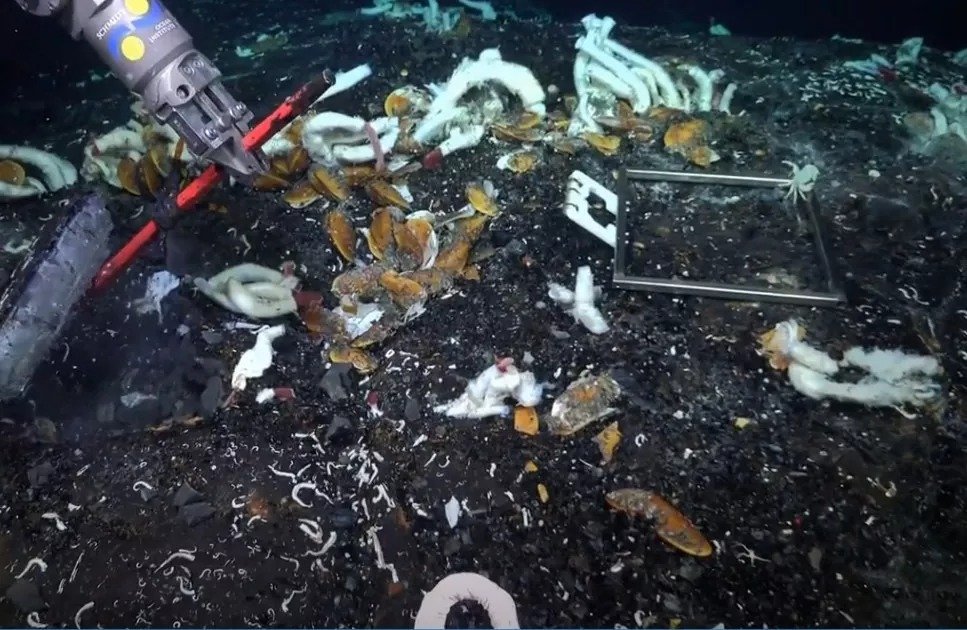
Scientists have made a groundbreaking discovery of giant white worms living beneath the seafloor in the eastern Pacific Ocean, near the Galapagos Islands, challenging previous assumptions about life in such extreme environments.
Researchers from the non-profit Schmidt Ocean Institute found the worms last year while excavating hydrothermal vents below the ocean floor.
The discovery, published in Nature Communications, reveals that complex life can thrive in conditions previously thought to support only microbes.
The worms, belonging to species Oasisia alvinae and Riftia pachyptila, reached record-breaking sizes of up to 20 centimetres and 50 centimetres in length, respectively.
To our knowledge, this is the first report of animals excavated from fluid-filled, shallow cavities in the seafloor of deep-sea hydrothermal vents, the researchers wrote in their study.
The worms were found squeezed under plates of solidified lava along the East Pacific Rise, an oceanic ridge where several tectonic plates meet off the coast of southwestern America.
Hydrothermal vents, formed in volcanically active areas, can reach temperatures of up to 400 degrees Celsius.
The discovery of these worms in such an environment has surprised scientists who previously believed only microbes could survive there.
To investigate the possibility of the seafloor acting as a reservoir for larvae, the scientists deployed a remotely operated vehicle (ROV) 2,515 metres below the sea surface.
They lifted plates to reveal adult male and female tubeworms capable of reproducing beneath the seafloor.

Evidently, there is a continuous habitat for tubeworms from seafloor cavities to the surface of the seafloor, the researchers concluded, supporting their hypothesis of larval dispersal in the subsurface oceanic crust.
(philenews with information from in.gr)

