


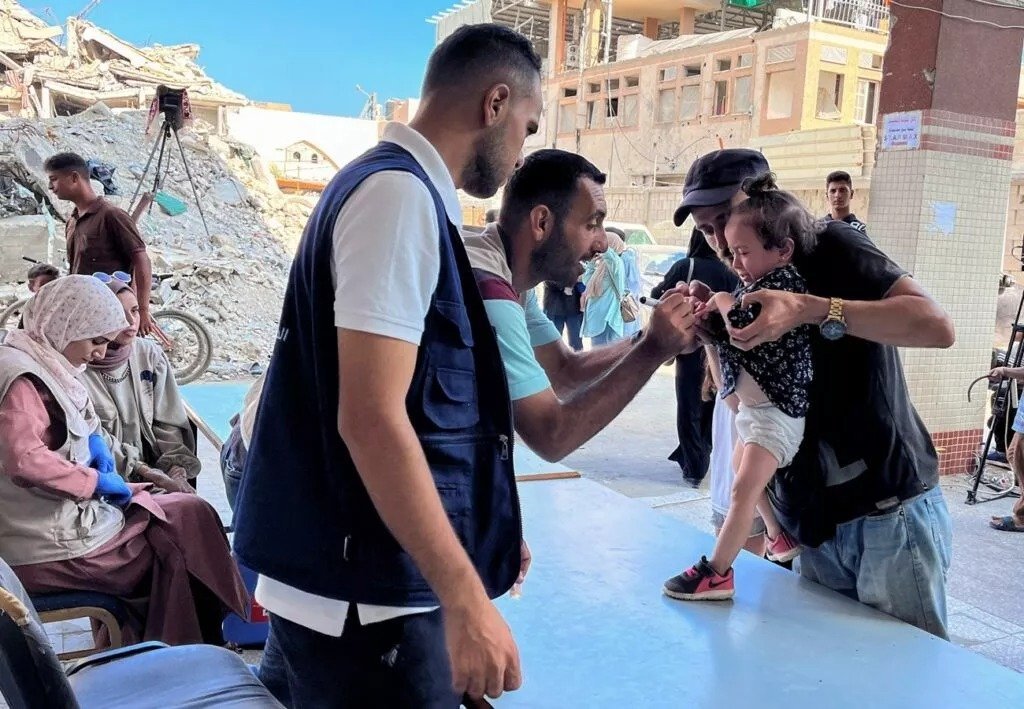
The World Health Organisation (WHO) is in talks with Israel to secure temporary ceasefire in large-scale military operations in the Gaza Strip, aiming to administer the second dose of polio vaccine to hundreds of thousands of children.
Ayadil Saparbekov, the WHO senior official responsible for Palestinian territories, explained during a Friday press conference that plans for an immunisation campaign between October 14 and 29 have been submitted.
The goal is to provide the crucial second dose of polio vaccines to 590,000 children under ten years old, along with vitamin A to boost their immune systems. Saparbekov expressed hope that the campaign would be completed within ten days.
Dr Saparbekov stated that, similar to September, the Israeli military needs to implement operational pauses to allow volunteers to administer the oral vaccines at special centres and in homes.
WHO Chief Tedros Adhanom Ghebreyesus called last month’s campaign, where over 560,000 children received their first polio vaccine dose, a “huge success”.
The campaign was organised after the first case of this highly infectious disease was detected in a 10-month-old infant in the besieged Palestinian enclave.
The Gaza Strip has been at war since 7 October 2023, following an unprecedented Hamas incursion into southern Israel.
According to AFP’s count based on official Israeli data, 1,205 people were killed on the Israeli side, mostly civilians, including those killed while held hostage by Palestinian Islamic movement fighters.
At least 41,788 Palestinians, mostly civilians, have been killed in retaliatory military operations in the small enclave, according to figures from Hamas’s Health Ministry, deemed reliable by the UN and WHO.
Dr Saparbekov highlighted that over 6% of Gaza’s population has been killed or injured in the war, which will mark its first anniversary on Monday.
He emphasised the severe impact on Gaza’s health system due to repeated attacks on facilities and chronic shortages of equipment, medicines, fuel, and personnel.
Only half of Gaza’s hospitals are partially functional, with the percentage dropping to 43% for health centres. Medical evacuations outside Gaza remain very limited.
As of September 30, out of 15,600 requested medical evacuations, only 5,138 (33%) were approved by Israeli authorities, according to Dr Saparbekov.
Since the closure of the Rafah border crossing with Egypt, only 219 patients have been evacuated from the enclave.
Malnutrition is another growing concern. Since January, 20,241 children have been treated for malnutrition, with 4,437 of them for extreme acute malnutrition, according to WHO figures.
(information from amna.gr)
(image source: Reuters)

