


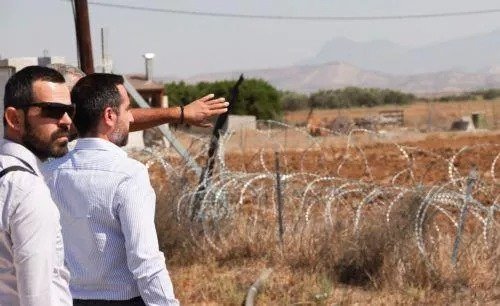
The Deputy Minister of Migration, Nicholas Ioannides, has conducted an inspection of the buffer zone and held meetings with affected residents, where he was briefed on the challenges they face due to the fence erected to restrict the movement of migrants from the occupied areas.
Ioannides stated that a study to evaluate the effectiveness of the fence has been commissioned, and a proposal will be prepared for the President of the Republic, after which a decision will be made.
This re-evaluation, according to the philenews sources, will concern both the purpose for which the fence was erected and the fact that it is one of the issues raised by the UN Secretary-General in the last two years.
As the report says “the unauthorised 14 kilometres of concertina wire fence placed in the buffer zone by the Republic of Cyprus in 2021 and 2022, against the mission’s protests, has not been removed despite previous indications that it would be”.
The Deputy Minister met with members of the occupied Avlona Community Council at the offices of the neighbouring Akaki Community Council and then visited the buffer zone in the area near Akaki and occupied Avlona.
Speaking at the site, Ioannides explained that his visit aimed to assess the situation on the ground and gain a first-hand understanding of the issues faced by residents, especially farmers cultivating fields within the buffer zone.
Ioannides assured the residents that the President and the Government were listening to their concerns and that he was there to hear their perspectives directly.
“Following our previous meeting, I wanted to see the situation for myself and get a clearer understanding. As mentioned, in collaboration with the Minister of Justice, an operational assessment of the fence will be conducted, and a proposal will be prepared based on the findings,” he noted.
When asked if the fence serves any purpose, Ioannidis clarified that he cannot provide an operational evaluation but acknowledged that it creates practical problems for residents, which is why he came to listen and observe.
“Once we receive the Police’s report as the security body, we will have a comprehensive understanding,” he added.
Asked if the fence could be relocated based on the findings, the Deputy Minister confirmed that the authorities would make an informed decision and provide a proposal to the President, taking into account the assessment’s conclusions.
Regarding the number of migrants currently in the buffer zone, Ioannides stated that there are around 70 people in two camps within the zone.
The Republic of Cyprus’s temporary suspension of asylum applications prevents their entry into government-controlled areas.
The stranded group includes women and children from Afghanistan, Sudan, Cameroon, and Iran.
He emphasised their engagement with the UNHCR to find a solution, acknowledging the humanitarian aspect while also firmly stating their position against creating a new passage through the Green Line, especially in the absence of sea crossings.
This year has seen a rise in migration across the Green Line from the occupied territories. In response, the government strengthened patrols along the buffer zone. Newly recruited officers conduct continuous patrols to deter migrant arrivals. This follows Cyprus’s decision to suspend asylum applications for Syrian nationals.
The U.N. human rights office stated earlier this year that based on evidence it has gathered, Syrian refugees who fled the ongoing Syrian civil war are facing gross human rights violations such as torture and abduction on their return to Syria, while women are subject to sexual harassment and violence.
Ioannidis pointed out that the UNHCR’s mandate is to protect refugees, and they approach the issue solely from a humanitarian perspective. However, he talked of the complexity of the problem, requiring a holistic approach that considers political and legal aspects as well.
When asked about potential changes to the surveillance of the Green Line, the Deputy Minister explained that it is an operational matter, but he assured that a dedicated surveillance unit is already in place.
“The Republic of Cyprus is committed to properly monitoring the Green Line, as mandated by the Green Line Regulation, and it will never allow it to become a border,” he stated.
Asked if the Republic is prepared for potential new migratory flows, considering the volatile situation in the Middle East, Ioannidis confirmed the update of the ‘Nafkratis Plan’ for migration management and the existence of other national plans for evacuations and crisis management.
He noted that the Cypriot mechanism is ready to manage the situation depending on the circumstances, clarifying that conflict in the region does not automatically lead to new migratory flows.
Regarding the complaint filed by KISA (Action for Equality, Support, Antiracism) against the Republic of Cyprus in the Administrative Court, the Deputy Minister confirmed that some individuals in the buffer zone have filed applications through a lawyer, requesting access to asylum procedures. He added that the Republic, through the Law Office, is handling the matter in collaboration with relevant ministries and services, and a solution is expected from the Court.
Haris Loizou, a member of the Avlona Community Council, stated that the fence serves no purpose and creates unnecessary problems for residents. “That’s why we invited the Deputy Minister to witness the situation firsthand,” he said.
Loizou explained that the fence only delays someone’s passage momentarily and that anyone can cross it within two minutes. Due to those two minutes, it continues to create numerous problems for residents in the area, he added.
Regarding the gate installed on the Akaki-Avlona road, Loizou said that the UN peacekeepers use it to conduct checks and prevent farmers from accessing their fields, requiring them to show a pass.
He called on the Government to consider providing additional incentives to encourage activity in the buffer zone, ensuring a presence in the area. “This is how we assert our claim over this land. Our presence here is crucial to defending our territory. If we weren’t here, this area would be lost,” he concluded.
Read more:

