


Concerns over a proposed bill to criminalise fake news are growing, with reactions now extending beyond the journalistic community to include a member of the country’s parliament.
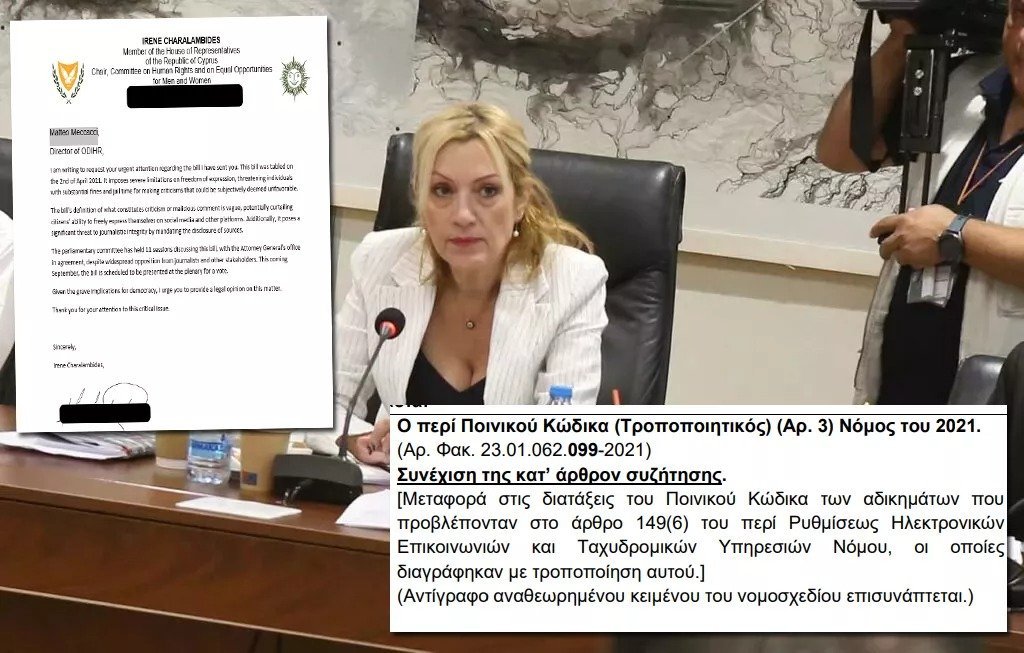
In a letter to Matteo Meccacci, the Director of the Office for Democratic Institutions and Human Rights (ODIHR) at the OSCE, MP Irene Charalambidou, in her capacity as the chair of the parliamentary committee on Human Rights, has sought his immediate attention and intervention regarding the controversial bill.
Charalambidou outlined her concerns about the bill, stating that it “imposes significant restrictions on freedom of expression, threatening individuals with hefty fines and imprisonment for expressing criticism that could be subjectively deemed malicious. The bill’s definition of what constitutes criticism or malicious comment is vague, potentially limiting citizens’ ability to express themselves freely on social media and other platforms.”
She further emphasised that the bill “poses a significant threat to journalistic integrity by requiring the disclosure of sources. The parliamentary committee has held 11 sessions to discuss this bill, with the Attorney General’s office agreeing despite widespread opposition from journalists and other stakeholders.”
In closing her letter to Meccacci, she noted: “This bill is set to be presented to the plenary for a vote in September. Given the serious implications for democracy, I kindly request that you provide a legal opinion on this matter.”
Speaking to philenews on Wednesday, Charalambidou expressed her intention to invite ODIHR officials to Cyprus to present their opinion on the matter through a public process.
The bill, which amends the criminal code, was last discussed by the parliamentary Legal Affairs committee on July 3, 2024. The reactions expressed were not limited to the journalistic community. Notably, lawyer Elias Stephanou, representing the Cyprus Bar Association, stated that the amendment effectively abolishes journalistic privilege.
In contrast, the committee’s chair, Nicos Tornaritis, and the Assistant Attorney General, Savvas Angelides, supported the bill.
It is worth noting that there was initial confusion over the origin of the bill, as it was considered a private member’s bill proposed by the committee chair, Nicos Tornaritis. However, on the agenda of the said meeting, it was presented as a ‘government bill’, with the text having been revised. A similar bill had been tabled in 2021 during the tenure of Minister Emily Yiolitis.
Following efforts by the Union of Cyprus Journalists, the issue caught the attention of the International and European Federations of Journalists (IFJ and EFJ, respectively). In a public statement released on Tuesday, the two organisations “join their Cypriot affiliate, the Union of Cyprus Journalists (UCJ-ESK), in denouncing this criminalisation of fake news and its chilling effect on press freedom.”
They further called on the Cypriot authorities “follow the recommendations of the Council of Europe, the European Union and the Organisation for Economic Co-operation and Development (OECD), which advise governments against adopting legal provisions criminalising disinformation, given the risk of chilling effect on press freedom and free speech.”
Concluding their statement, they asserted their belief that “the best antidote to disinformation is the promotion of a healthy information ecosystem, which favours media literacy, quality information, ethical journalism, independent and pluralistic media, decent working conditions for journalists and the promotion of a culture of transparency. Wherever repressive laws have been passed, they have proven to be ineffective, counterproductive, or even diverted from their official objective to intimidate journalists or encourage them to self-censor.”
The Council of Europe also issued an official statement supporting the positions of the Union of Cyprus Journalists on Wednesday. Additionally, the Press Ethics Committee added its voice to the chorus of reactions against the bill on Thursday.

