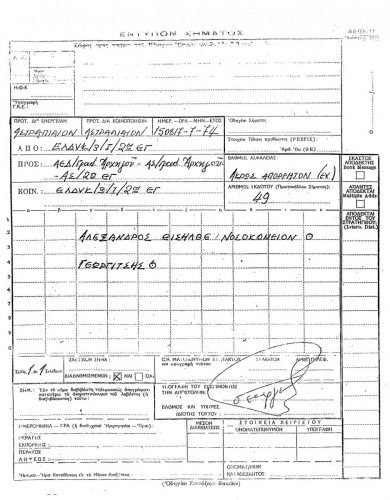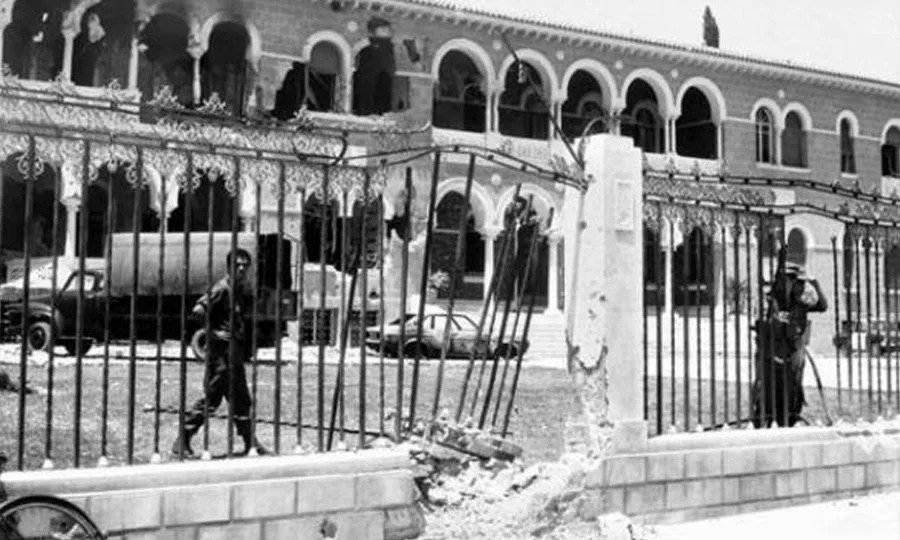
The code phrase for the coup d’état of July 15, 1974, was “Alexander entered the hospital.”
The order was signed by the junta officer Georgitsis and addressed to the National Guard, described as ELDYK 3. The signal was also communicated to the headquarters of the Greek Armed Forces in Athens, which gave the orders and planned the coup.
After all, Georgitsis was Ioannides’s and the junta’s loyal man in Cyprus.
- The date was July 15, 1974, at 8:17 am, with the protocol number of the signal being 49.
Furthermore, the following code phrases were part of the conspirators’ plan, to be used depending on the course of the coup:
“Alexander is doing well” indicated that the coup had a good progression.
“Alexander is gravely ill” signalled that the coup was not progressing well.
With the first order, the coup was set in motion, and it proved to be disastrous for the country.
The months leading up to the July 15 coup were marked by intense activity. As evidenced by orders given to the junta members, Ioannidis’s decision was to create political instability in Cyprus.
Based on these orders, “collaboration with EOKA B consisted of developing a chain of incidents in collaboration with groups of soldiers to incite unrest.” The entire scenario was staged with the goal of completing everything before July 20. And this was because, until then, “the National Guard would maintain its current form, structure, and staffing.” But there was more to it, as subsequent events confirmed.
As is well known, on July 13, 1974, a meeting was convened in Athens under Gizikis to discuss “the Cyprus issue.” The meeting did not conclude, and it was decided, allegedly, to continue it on Monday. The coup took place on Monday!
This followed Makarios’s letter to Gizikis requesting the recall of Greek officers from Cyprus due to their subversive role. However, this letter was neither the cause nor the trigger for the coup. After all, as the events indicate, the decision to carry out the coup had been made long before.
For the record, the decision to overthrow Makarios was made by the following:
- Phaedon Gizikis, President of the Republic,
- Adamantios Androutsopoulos, Prime Minister,
- Dimitrios Ioannidis, leader of the junta,
- Grigorios Bonanos, Chief of the Armed Forces.
Ioannidis was the director of this ‘orchestra’ and the instigator, designer, and planner. He did not act alone or impulsively. It was a plan known to the Americans and the Turks.
It was pre-determined
It was obviously not a last-minute decision. There had been repeated consultations between the four leaders of the junta, mentioned above, at Androutsopoulos’ home.
According to Bonanos’s testimony (Investigative Committee of the Hellenic Parliament, 16, 17.12.1986), these consultations began in February 1974. Additionally, he stated: “I do not know Ioannidis’s reasons. However, it is a fact that he had the overthrow of Makarios in mind since February 1974, and he presented it in the presence of Androutsopoulos, Gizikis, and myself.”
He made his final decision to participate in Makarios’s overthrow on June 30, 1974, when he was informed of Makarios’s letter. However, the letter was delivered on July 3, 1974, and the order to overthrow Makarios was given at the July 2 meeting.
In the ‘Cyprus File,’ Bonanos’s reference to his book, ‘The Truth: April 21: November 25: The Cyprus Issue,’ Athens 1986, is also noted. In this book, Bonanos mentions that Ioannidis had premeditated the coup much earlier, even before November 25, 1973, when Makarios was scheduled to be away on an official visit to China.
According to Gizikis’s testimony, the decision to carry out the coup was made in April 1974. Pilichos, Ioannidis’s confidential witness, places the decision-making time frame for the coup two to three months before July 15, 1974.
The final decision of the four junta leaders was made in the second half of June 1974. The implementation process of the coup began in the last days of June 1974, with Ioannidis and Bonanos selecting July 15, 1974, as the day of the coup.
They also chose officers of the National Guard, Michael Georgitsis, commander of the III ATD, and Konstantinos Kompokis, commander of the Commando Forces, to carry out the coup. The dates are not as important as the fact that the goal of the coup was set.
According to the ‘Cyprus File’ of the Hellenic Parliament, on July 1, 1974, by order of the AED General Gr. Bonanos, a marching order was issued for Michalis Georgitsis and Pavlos Papadakis to report to Athens. Papadakis served as the deputy chief of the GEEF until the beginning of June 1974. The order to Georgitsis was given directly to him, bypassing the GEEF and its chief, Lieutenant General Ntenisis.
The planning continued with a meeting held on July 2, 1974, at 7:30 pm, in Bonanos’s office at the AED, attended by the following: Dimitrios Ioannidis, colonel, Grigorios Bonanos, general, Chief of the Armed Forces, Pavlos Papadakis, brigadier, commander of the 10th Division based in Evros, Michael Georgitsis, colonel, commander of the III ATD of the NG, Konstantinos Kompokis, colonel, commander of the Commando Forces of the NG.
At this meeting, Bonanos informed those present of the decision to overthrow Archbishop Makarios through a military coup, a decision, he said, made by the government and the military leadership. At the same time, he set July 15, 1974, at 7:30 am, as the time for the coup and appointed Georgitsis as the leader and Kompokis as the deputy leader.
The only thing that changed was the time of the coup, which took place at 8:20 am. The reason given for the change was that at 7:30 am, there was traffic on the roads, and it would have caused more bloodshed. This was the excuse given for the change in timing.
The coup’s goal was the partition of the island
The July 15 coup was designed and executed with the aim of dividing the island of Cyprus. And this particular plan dates back to the 1970s. The imposition of the dictatorship in Greece was part of this puzzle. The junta in Greece was not established because of a supposed communist threat or internal political instability in the country.
The Left, after the civil war, the defeat, the imprisonments, the exiles, and the population transfer to the countries of the so-called real socialism was not a threat but was being persecuted. The junta was imposed because of Cyprus and its partition.
- It should be noted that, from 1971 onwards, in the Americans’ on-paper scenarios, the possibility of partition was a basic element. It was considered a scenario with a higher probability of success. They assessed the possible reactions of the parties involved, but at the same time, they also gave their own stamp and their own pursuits. The strategic interests of the US in the region would be satisfied through these plans.
- In 1974, the American secret services, acting in concert with Henry Kissinger, the former powerful man of the State Department, the Greek junta, EOKA B, and the politico-military establishment in Ankara, with different starting points and pursuits, found themselves in the same trench. The overthrow of President Makarios on July 15, 1974, and the Turkish invasion five days later were two events of the same plan.
Many present the issue as a result of the hatred that Dimitrios Ioannidis harboured towards Makarios. This was true, but it was not the main reason that led the junta and its local agents to the coup against Makarios. The reasons were deeper.
Cyprus was the collateral damage of the raging Cold War at the time. It was the Iphigenia who had to be sacrificed to maintain the balance between Greece and Turkey and in the region. The coup was carried out to divide Cyprus.
Makarios downplayed information about a coup
The atmosphere in the period before the coup was tense. There was information about an impending move by the junta and its agents, EOKA B, to overthrow Makarios. Why were no measures taken? Why did Makarios downplay this information? Did he trust that the junta members were logical?
A significant revelation was made on July 5, 1974, by the newspaper ‘Haravgi,’ the mouthpiece of AKEL. In the newspaper’s article, presented with bold headlines, it is stated:
“A plan for a diversion and bloodshed, to be executed before July 20, has been devised by the masterminds and leaders of EOKA B, according to information obtained by ‘Haravgi.’ The purpose of this plan is said to be “the salvation of the National Guard” and the thwarting of the decided measures regarding the reduction of conscription and the recall of Greek officers. In reality, this plan fully aligns with the broader conspiracy’s primary goal of overthrowing President Makarios and imposing a regime of internal occupation.
In implementing the above plan, the conspirators ordered the concentration of their forces (active and reserve) in the five major cities, especially in Nicosia, where, according to the plan, “the decisive blow will be delivered”.
Already, according to our information, camouflage uniforms have begun to be distributed to all “loyal and devoted” members of EOKA B, while arrangements have been made for the mobilisation of the necessary population at the appropriate time.
Furthermore, the “decisive blow” in Nicosia is said to consist of developing a chain of “incidents” between National Guardsmen and security forces, the assassination of government and political personalities, the incitement of widespread unrest, culminating in the occupation of the Presidential Palace, the Radio Station, CYTA, and other “nerve centres”.
Although the plan envisages a gradual escalation of actions, the conspirators-planners have determined that it should be carried out clearly before July 20, while the National Guard still maintains its current composition, structure, and staffing. (As is well known, it is estimated that after this date, 5,000 men will be discharged from the current National Guard force, including those who have completed their two-year conscription and those who enlisted in January 1973).
The same planners attach particular importance to the fact that until July 20, about 650 Greek officers will still be serving in the National Guard. Therefore, they say, “the exploitation of this factor” should be done before its weakening.”
‘Haravgi’ also reports in the same article that the Government is aware of this information and is taking measures.
Phileleftheros (philenews), on Saturday, July 6, 1974, in its main article, refers to statements by President Makarios under the title “Attempt to introduce dictatorship in Cyprus” and “we will not allow the dissolution of the state and the transformation of the National Guard into an occupation army.”
The newspaper reported that “relations between Athens and Nicosia are not harmonious. The responsibility for this lies with the Greek Government, as elements of the military regime are behind the conspiracy in Cyprus, as indisputably confirmed by documentary evidence. Regarding relations between the Greek and Cypriot Governments, Archbishop Makarios, the President of the Republic, spoke yesterday in revealing statements regarding the reasons that “caused the relations between Athens and Nicosia to be put to a serious test,” as well as the developing internal situation and the determination to deal with any eventuality.”
Makarios, in response to a question, said:
- The main reasons for the disharmony in relations between Athens and Nicosia are the stance of certain National Guard officers and the involvement of the military regime’s elements in the criminal activity of EOKA B.
- Unwanted tendencies towards the introduction of a dictatorship in Cyprus and the transformation of the National Guard into an internal occupation army have emerged.
- As long as EOKA B’s terrorist activity, directed from Athens, continues, cooperation between the two governments is difficult.
The newspaper ‘TA NEA,’ the mouthpiece of EDON, had written in its front-page article on July 5 about a mutiny within the National Guard and the incitement of bloodshed, naming Athens as the mastermind behind this plan.
It also linked this plan to incidents that took place in Nicosia, where National Guardsmen were shouting that they belonged to the Greek army. In this article, ‘NEA’ mentions the former commander of ELDYK, Colonel Kondylis, who remained in Cyprus even though his term had ended. The reason for his prolonged stay was revealed on July 15.
The Tompazos testimony
Then-Head of KYP (Cyprus Intelligence Service-CIS) Georgios Tompazos, on instructions from President Makarios, secretly left on a three-day mission abroad on July 6, 1974, to seek help to avert the impending coup.
He never publicly revealed the country he visited. In an interview with the newspaper ‘O AGON’ (29.4.1979, with journalist Kostakis Antoniou), he revealed that shortly before Georgios Grivas’s death, the Athens junta was promoting a coup plan in Cyprus in collaboration with EOKA B.
This plan envisaged the occupation of Troodos and the declaration of union with Greece.
Vlachos and Averoff
Another testimony is that of messages conveyed to Nicosia by Ambassador Angelos Vlachos through Ambassador Nikos Kranidiotis.
Angelos Vlachos had been informed by the American ambassador, Tasca. Tasca showed him two telegrams from Kissinger, instructing him to find Ioannidis and deter him from taking action against Makarios.
Moreover, Evangelos Averoff learned of this, as he testified in the ‘Cyprus File,’ between the delivery of Makarios’s July 2, 1974, letter and the coup, specifically on July 10 or 12, 1974, from Tasca, who showed him three telegrams from Kissinger.
Averoff did not convey this information to Kranidiotis, while another piece of information he had from a friend, an agronomist, as he testified to the Committee, he did convey, which is also confirmed by Kranidiotis in his book, giving the reasoning that the documents were confidential from the USA. Kranidiotis, in the aforementioned book, states that Makarios had an inexplicable certainty that a coup would not be carried out against him.
And another recent testimony, published in Phileleftheros, is that Nikos Kranidiotis had asked businessman Kostas Maglis, who was in Athens, to convey information from Averoff to Makarios.
After arriving in Cyprus, Maglis asked to meet with the Abbot of Kykkos, Chrysostomos, who called the Director of Makarios’s office, Haris Vovides, to the meeting, where he was informed.
The Abbot had tried to contact Makarios, who was at his country residence in Troodos. Oral testimony suggests that Haris Vovides, under the Abbot’s insistence, picked up the phone and dialled the number of Makarios’s living room. Makarios answered the phone. Haris Vovides explained the purpose of the call and asked him to speak with the Abbot of Kykkos.
The fact that the Archbishop told him that he could meet them (the Abbot and Maglis) on Monday at the Presidential Palace angered the Abbot, who abruptly hung up the phone.