


The landscape surrounding workers’ rights is undergoing significant transformations, influenced by evolving labour laws, new technologies, rising precarity and ever-changing economic dynamics.
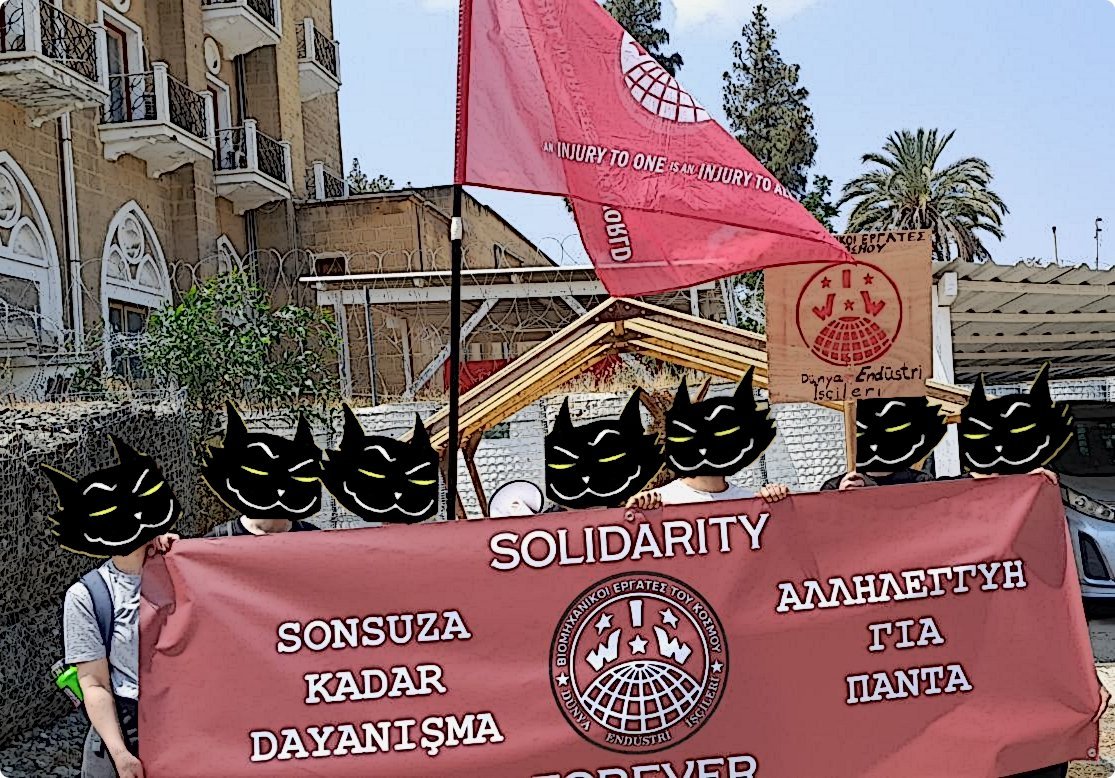
Amidst these changes, the Industrial Workers of the World (IWW), a global labour union first formed in Chicago in 1905, has been organizing in Cyprus since 2020, aiming to empower local workers, facilitate and support collective action, and challenge systemic inequalities in the workplace.
In an interview with in-cyprus, Alex P., the Secretary and Treasurer of the Cyprus Regional Organising Committee of IWW, speaks about the need for labour rights, collective action, and the role of grassroots organizing in safeguarding workers’ interests.
What is the landscape surrounding workers’ rights in Cyprus?
When it comes to rights deriving from labour law, most of them were established in the early 2000s, due to Cyprus’ then imminent entrance into the European Union; Cyprus’ labour law has been developing since then based entirely on EU directives.
All pre-existing labour laws are either from the 1960s when the Republic was first established, with some of them originally being colonial-era mandates, dating as far back as the 1930s; all these remain mostly unchanged since then.
The reason behind this lack of legislation is the simple fact that Cyprus’ industrial relations, not unlike those of certain northern European countries, were based mostly on collective agreements that used to cover the vast majority of the workforce.
Nowadays, around 40% of workers are covered by collective agreements, in the public and private sectors.
Falling trade union membership and collective agreement coverage, a phenomenon which originated in the 1980s but reached Cyprus in the mid to late 2000s, led to trade unions pushing (by lobbying and occasionally mobilising their membership into isolated symbolic protests) for further legal protection.
However, it was not until the last couple of years, years characterized by record profits, low and decreasing unemployment and stagnated wages, that Cyprus began taking some shy initiatives, incorporating into its labour law the relevant EU directives.
What changes have happened in the last couple of years?
Some important examples of positive developments are the establishment of a national minimum wage (not universal and however problematic as it may be), an increase to the Cost Of Living Allowance – COLA (still at only 66.7% and only for those workers who receive it), a very much delayed regulation of telework, a still incomplete extension of social insurance rights to the self-employed, two extensions to the length of the compensated (70% of the salary) maternal leave and the introduction of compensated paternal and parental leave (again, 70% of the salary, and the latter of the two at the discretion of the employer).
We can also note the locking of the trial employment period to six months tops (a length which was deemed a violation of the European Social Charter by the European Committee of Social Rights on numerous occasions), a law regarding the immediate access to the right of annual leave (with the previous law violating an EU directive established in the 90s), as well as laws regarding the transparency of wages and the right of employees to be informed about their essential employment terms in a timely manner.
In addition to the problematic aspects of the above – generally positive – developments, there are still serious gaps in legislation, one important example being the privilege of employers to withhold pay for sick days; the first three days of being absent due to sickness might be unpaid, and any further absence is then covered by the Social Insurance at a reduced rate, six months (at the earliest) after the fact.
However, the most important issue with workers’ rights is the severe problem with the control and enforcement of the relevant legislation.
The relatively recent reformation of the Labour Inspections Services did little to help, with fines being too low (certain right and far-right parties made sure of that when the legislation was passing), and with the Services remaining understaffed compared to the number of workplaces in Cyprus and mostly focused on combating undeclared work.
As for individual action, taking a case to court takes money and time (average length of a labour law trial is 5-7 years, not including appeals), the compensation a worker can win is minimal unless they have been working at their job for a decade at least, and, in the case of illegal dismissals, the courts ordered the reinstatement of the employee only once or twice in the entire history of the Republic, despite having the power to do so in every such case.
To give a mind-boggling example, consider this: as a rule, compensation for illegal dismissal is equal to the compensation an employee would receive if they were declared redundant; as such, if a court finds that an employee was illegally fired by being wrongfully declared redundant, the compensation awarded to them will be equal to the money they would have gotten if they had not taken their case to court, avoiding the legal expenses and the general hassle.
The only recourse is collective action; in simple words, workers must be organised, which means nothing more than having developed strong ties of support and mutual aid between them (regardless if they form or are members of officially recognized trade unions), must be aware of their rights, and must be ready to react whenever those rights are infringed upon, considering an injury to one of them to be an injury to all.
That is the only way to solve issues right then and there, to immediately nip them in the bud.
On a positive note, the right of collective organising and the right to strike are universal in Cyprus, which are protected by both the law and the Constitution.
There are important limits when it comes to the right to strike, especially strikes organised by trade unions.
Those limits are both legal and customary and are heavily tied to the way employment relations were handled in the first decades of the Republic.
However, for now, at least, there are ways to circumvent those limits, by branding a strike a “work stoppage” for example, regardless of its length.
With the number of strikes increasing these days, it is not surprising that employers’ organisations are lobbying hard for further legal limits to the right of strike, especially in the so-called “essential services”.
How can emerging challenges be addressed, such as increasing automation, replacement of workers by AI and the rise of precarious employment?
Most of the listed examples can hardly be called “emerging” challenges, at least in Cyprus.
Automation, for example, is something that is constantly happening throughout the centuries of industrial development. Historically, it did not cause massive unemployment, despite what most people think, but on the contrary, it led to an increase in labour demand.
It did however cause a deterioration in working conditions, as work became faster and more demanding, and unskilled low-paid labour took the place of skilled and highly paid workers; the former being easier to fire and replace than the latter as well.
When employers advocate for automation, claiming that it does not lead to unemployment, well, they are right, but in the worst possible way.
Nonetheless, in Cyprus factories are limited, both in size and number. We witness rising automation in other important sectors, for example, the ordering process for restaurants that provide delivery (or even in-shop ordering in certain fast food chains), or the self-checkouts in supermarkets; however, this has not translated in the loss of jobs, or, for this specific examples, the deterioration of working conditions for the workers involved; probably due to those jobs being as terrible as possible to begin with.
Trying to cultivate a climate of fear and technophobia is common in times when the profits of employers can absolutely justify an increase in wages and general improvement of working conditions, so a boogeyman is needed to keep the demands of workers and trade unions to a minimum.
It happened in the 1980s and 1990s, to coincide with the onslaught against organised labour in the US and the UK and the beginning of its downfall all around the “western world”, which, as an immediate result, led to the shrinking of labour rights; all this despite the fact that the period from the mid-1980s to the late 2000s was a time of financial growth record profits, just like the last couple of years (when referring to food delivery and supermarkets, those years of record profits include the pandemic period).
It is also important to always keep in mind that behind every new technology, there are workers developing and updating it, handling it, producing the raw materials to build it etc.
For example, in early 2023, Time magazine revealed that ChatGPT’s safety system (barring harmful content like violence, sexism, racism, sexual abuse etc.), is run by outsourced workers in Kenya, paid less than $2 per hour to be exposed to all this vile content for many hours on a daily basis, in order to label it as harmful and keep it away from the users.
What about the effects of automation in Cyprus?
The only sector that is currently severely impacted by automation in Cyprus is the banking sector.
One of the strongest labour forces just a few years back, and a pioneer for the extension of labour rights (for example, we do not have legally defined universal public holidays in Cyprus, but we have bank holidays), is now shrunk to a shadow of its former self, with the relevant trade unions prioritising getting their members the best-compensated exit schemes and early retirement plans, rather than improving the working conditions.
Organising the new hires, who are mostly temps, appears to be even lower in the priorities of the trade unions, despite them becoming the vast majority of the workforce in the sector.
Which brings us to precarious employment.
If collective organising is the remedy, as advocated above, how to address issues like outsourced workers being exposed to Health and Safety hazards (including new ones like being exposed to the cesspool that the internet can be), issues like temporary work becoming the dominant form of employment not only in the private sector but in the public sector as well, issues like employees doing piecework for algorithmic platform companies being deemed self-employed and deprived of their labour rights, issues like companies which are proud to be workers’ “recycling” mills, issues like employees being encouraged or even force to be “nomadic”.
Moreover, how can trade unions and labour organisations establish a strong well-tied membership based on a workforce which is highly polarised, identifying with and divided by so many different labels?
Those are the true challenges of today’s organised labour, challenges that cannot be overcome unless there is a radical change in the organisational structure and strategies of these organisations.
And that is exactly what the Industrial Workers of the World (IWW) bring to the table.
Why form yet another trade union in Cyprus today?
First thing first, the IWW is not an officially recognised trade union, at least not in Cyprus.
The Cyprus Regional Organising Committee of the IWW (CYROC) is part of the ‘Wales Ireland Scotland England Regional Administration’ (WISERA), which, along with the North American Regional Administration (NARA), are the central administrative bodies of the global organisation.
Although the IWW is a recognised trade union in many countries, including the US, the UK, Canada, Ireland, France and others, getting such recognition is not a priority for our organisation; in fact, in the majority of countries that we have branches, Regional Organising Committees (ROCs) or at-large members (and we do have a presence in many countries and areas across North America, Europe and Asia), we do not actively seek such recognition.
In addition, and in strong relation to this, our organisation does not consider the signing of collective agreements the be-all and end-all of collective organising and action.
We emphasize rank-and-file organization, i.e. forming a strong, tightly-knit base of members.
We are a labour organisation created by the workers themselves, to serve their own interests, whether those are related to the workplace or the community where they live.
This model of organising belongs to what is called “solidarity unionism”.
Solidarity unions – unions in the broad sense of the word – consider every issue that a worker is facing to be a labour issue, regardless if it directly relates to their work life, an issue that can and must be dealt with collectively, through mutual aid and direct action.
Direct action (for example work stoppages of all kinds, marching on the boss and other forms of reaction in the workplace) is prioritised over mediated action like collective bargaining, electoral politics, negotiations and arbitration.
The main reason behind this is the simple fact that anything won by dedicated direct action and majority organizing, can not be so easily taken away when the collective agreement expires or when a government changes the law or chooses not to implement it. Direct action gets satisfaction.

